
Plant Encyclopedia

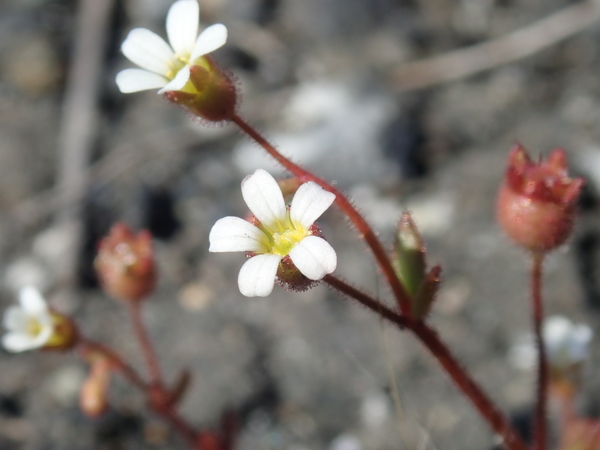
Saxifraga tridactylites (rue-leaved saxifrage, "Robokumomagusa")
Japanese name: ロボウクモマグサ (路傍雲間草)
Scientific name: Saxifraga tridactylites
[Overview]
An annual 5–20 cm tall, growing in its native range on sunny, dry rocky slopes and similar places.
It prefers alkaline soil.
The whole plant is covered with many glandular hairs and is sticky.
The stem branches at the base, and the whole plant often turns red.
The leaves are of two kinds, basal leaves and leaves arranged alternately on the stem, and are thick.
The basal leaves are simple, spatulate to elliptical, and are usually withered by the flowering season.
The leaves on the stem are about 0.2–2 cm long and are either divided into 3–5 lobes or simple and undivided.
The flowers form loose cymes to dense spikes, or are borne singly in the leaf axils; they are white, 5-petaled, and about 0.7–0.8 cm across.
The petals are elliptical and about twice as long as the sepals.
There are 10 stamens.
The fruit is a spherical capsule.
[History]
A naturalized plant reported in 2014; as of 2019, it is found mainly in the northeastern part of Shiga.
Details
Japanese: ロボウクモマグサ(路傍雲間草)
Translated from our Japanese encyclopedia. If anything differs, the Japanese page is correct.