
Plant Encyclopedia

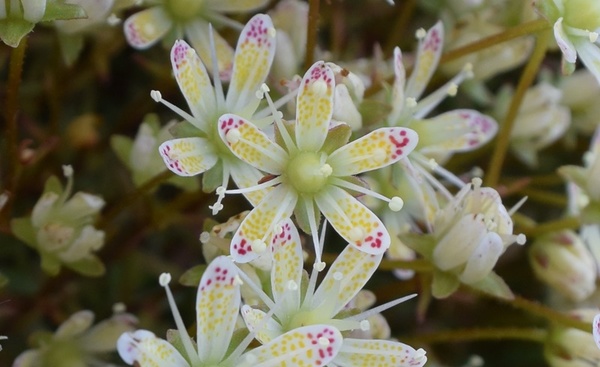
Saxifraga bronchialis subsp. funstonii var. rebunshirensis ("Shikotanso")
Japanese name: シコタンソウ (色丹草)
Scientific name: Saxifraga bronchialis subsp. funstonii var. rebunshirensis
[Overview]
A perennial growing on sunny rocky and gravelly ground in the subalpine to alpine zones.
The rhizomes branch freely and spread in a mat, forming a large clump.
The stems are short and tinged with reddish purple.
The leaves are simple and densely alternate, lanceolate, about 0.6–1.5 cm long and thick, with spiny hairs at the leaf tip and stiff bristles on the margin.
A flower stalk 3–12 cm tall rises up, and a cyme bears 2–10 flowers.
The flowers are white to yellowish white, about 1 cm across, with 5 petals; each petal has a yellow spot in the center and a red spot in the upper part.
There are 10 stamens.
The fruit is a broadly ovate capsule.
[Cultivation]
Propagate from seed or by division.
It prefers a cool environment.
Grow it in a dry, well-drained, well-ventilated place.
It likes sun, but in warm regions it is best moved to a well-ventilated place in partial shade to avoid direct summer sun and long rains.
Take care when watering so that it does not become too wet; for potted plants, water thoroughly after the soil surface has dried, and water sparingly in summer.
Apply a small amount of base fertilizer, and also place slow-release fertilizer on the soil in early spring, so that no fertilizer remains in summer.
There are no particular pests or diseases.
[Notes]
The name comes from the fact that it was first collected on Shikotan Island.
Details
Translated from our Japanese encyclopedia. If anything differs, the Japanese page is correct.