
Plant Encyclopedia

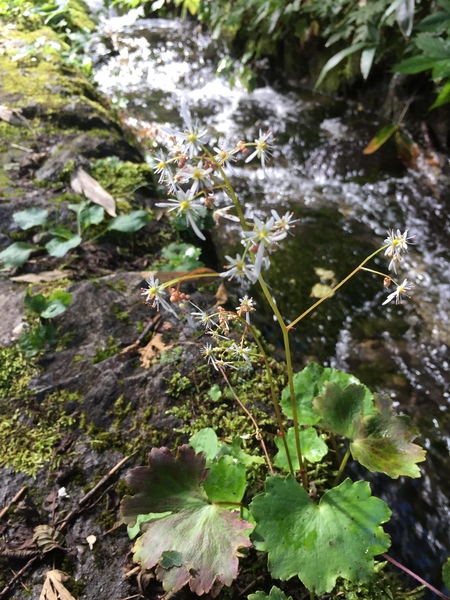
Saxifraga fortunei var. alpina ("Daimonjiso")
Japanese name: ダイモンジソウ (大文字草)
Scientific name: Saxifraga fortunei var. alpina
[Overview]
A perennial 5–40 cm tall, growing on constantly wet rocky ground such as along mountain streams, or as an epiphyte on trees.
It has short rhizomes.
The leaves are simple and arise from the base; they are fleshy and reniform, 3–15 cm long and 4–20 cm wide, with the margin shallowly palmately divided into 5–17 lobes.
The leaves are usually covered with long hairs.
The leaf stalk is 5–20 cm long.
It sends up a reddish flower stalk 5–40 cm tall, and a cyme bears sparse flowers.
The flowers are white or pale pink with 5 petals; the 3 upper petals are small and the 2 lower ones are large and spread in a splayed shape, forming the character 大.
In flowers that face upward, the 5 petals are almost the same length.
There are 10 stamens, and the anthers are red.
The fruit is an ovoid capsule 4–6 mm long.
Leaf shape and flower color vary widely by region.
[Uses]
The whole plant is used as a folk medicine.
[Cultivation]
Propagate from seed or by division.
Grow it in partial shade in a well-drained, well-ventilated, moist place.
It is best planted in light soil such as sand, pumice or Kanuma soil, or mounted on a stone.
High air humidity is also preferable.
When watering, keep the soil constantly moist so that it does not dry out.
From spring to autumn, apply diluted liquid fertilizer.
There are no particular pests or diseases.
[Notes]
The name compares the shape of the flower to the character 大.
Details
Translated from our Japanese encyclopedia. If anything differs, the Japanese page is correct.