EVERGREEN

Plant Encyclopedia

Tanacetum parthenium

Tanacetum parthenium (feverfew, "Natsushirogiku")

Japanese name: ナツシロギク (夏白菊)
Scientific name: Tanacetum parthenium

Tanacetum parthenium

[Overview]
A perennial about 30–80 cm tall.
The base of the stem becomes woody.
The leaves are alternate, deeply pinnately divided, with the lobes further shallowly divided.
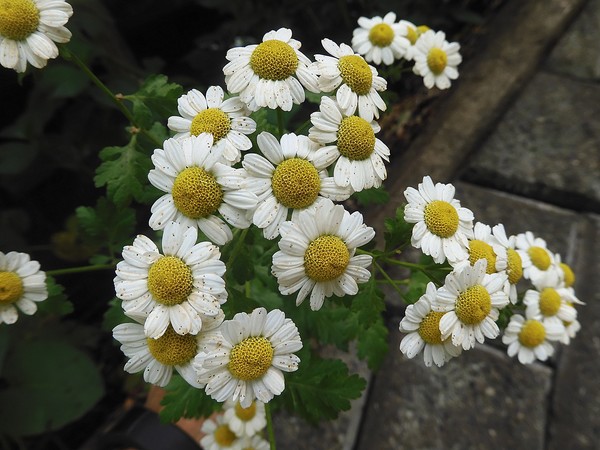
Many flower heads are borne in corymbs at the stem tips; each head has white ray florets around the edge and yellow tubular florets in the center.
The fruit is an achene.

[Uses]
In Europe it has long been used medicinally.

[Cultivation]
Propagate from seed or by stem cuttings.
It prefers a sunny, well-drained, well-ventilated place.
It dislikes heat and humidity, so it is best kept on the dry side: for potted plants, water thoroughly after the soil surface has dried; for plants in the ground, rainfall is sufficient.
Apply base fertilizer, and also place slow-release fertilizer on the soil in spring and autumn.
Aphids can be a pest.

Details

Names
English: feverfew, bachelor's buttons
Japanese: ナツシロギク(夏白菊)、マトリカリア、フィーバーフュー、フィーバーヒュー
Life form
Perennial
Habit
Terrestrial
Planting (or sowing) season
March, April, September, October
Flowering season
June, July
Distribution or origin
West Asia, Balkan Peninsula
Height
300–800 mm
Leaf shape
Lobed leaf
Leaf arrangement
Alternate
Inflorescence
Head
Flower color
Yellow, White
Leaf color
Green
Availability of seeds and plants
Low
Form sold
Seeds, Seedlings
Propagation
Seed, Bud cuttings
Sun exposure
Full sun
Water needs
Dry, Moderate
Soil needs
Required
Tolerance
Cold tolerance
Suitable uses
Potted plant, Flower bed, Parks and gardens
Hardiness zone
6a
Pests
Aphids
Uses
Medicinal
Japan Flower Trade Code
14413

Translated from our Japanese encyclopedia. If anything differs, the Japanese page is correct.

Sponsored