
Plant Encyclopedia

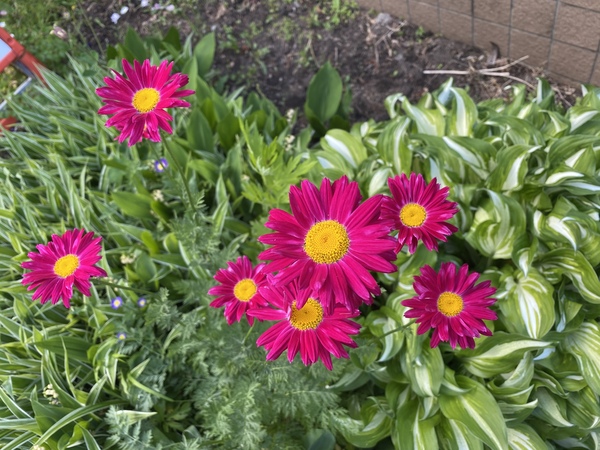
Tanacetum coccineum (painted daisy, "Akabanamushiyokegiku")
Japanese name: アカバナムシヨケギク (赤花虫除菊)
Scientific name: Tanacetum coccineum
[Overview]
A perennial 60–90 cm tall.
The leaves are alternate, pinnately divided to the base, with the segments further pinnately lobed to the middle, and the final segments notched.
A flower head about 4–7.5 cm across is borne at the tip of a long flower stalk.
The marginal florets are red and the central tubular florets are yellow.
The fruit is an achene.
[Uses]
It contains pyrethrin, an insecticidal compound, and the flower heads can be used as a raw material for insecticide, but because it contains less of the compound than Shirobana-mushiyoke-giku, it is grown mainly for ornamental use.
[Cultivation]
Propagate from seed or by division.
A sunny, well-drained, airy place suits it, and it prefers sandy soil.
With poor sunlight it becomes leggy and flowers poorly.
Stuffy conditions in summer weaken the plant, so take care to avoid excess humidity.
For potted plants, water thoroughly when the soil surface dries; for plants in the ground, rainfall is sufficient.
Once basal fertilizer has been applied, no further fertilizing is particularly needed.
If the stems and leaves grow too thick, the inside becomes stuffy, so thin out crowded parts as appropriate.
Cutting it back after flowering allows you to enjoy a second flush of flowers.
There are no particular pests or diseases.
Details
Japanese: アカバナムシヨケギク(赤花虫除菊)、アカムシヨケギク(赤虫除菊)、ペインテッドデージー
Translated from our Japanese encyclopedia. If anything differs, the Japanese page is correct.