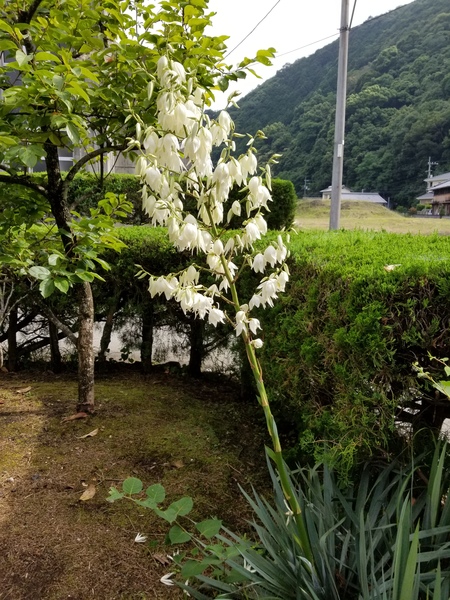
Yucca gloriosa var. recurvifolia(curve-leaf yucca, "Kimigayoran")
Japanese name: キミガヨラン(君代蘭) Scientific name:Yucca gloriosa var. recurvifolia
[Overview]
An evergreen shrub growing to 2 m tall.
The leaves are alternate and form a rosette at the top of the trunk, so that many leaves appear to radiate outward.
The leaves are sword-shaped, about 50–100 cm long and 3.5–5 cm wide, with pointed tips.
Mature leaves curve.
A panicle about 90–110 cm long bears many flowers.
The flowers are about 4–5 cm across, bell-shaped with 6 petals, white with faint purple streaks, and bloom facing downward.
The fruit is a capsule, but in Japan it does not set fruit because the yucca moth, the pollinating insect, is absent.
[Cultivation]
Propagate by division or cuttings.
It can overwinter outdoors except in cold regions.
It prefers a sunny, well-drained site.
It does better on the dry side, and rainfall is sufficient.
If organic fertilizer is applied as a base fertilizer together with a small amount of lime, no further fertilizer is needed for several years.
There are no particular pests or diseases.