
Plant Encyclopedia

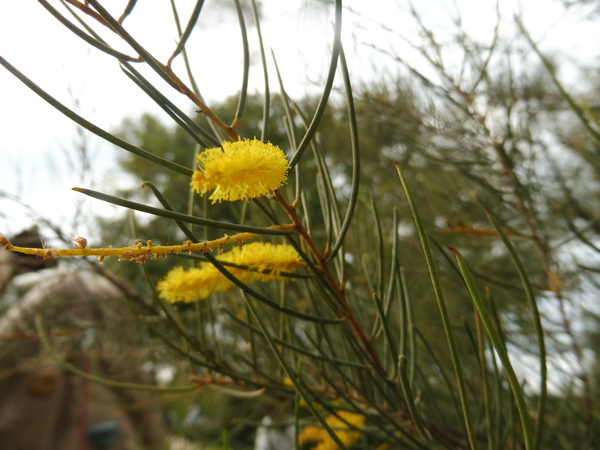
Acacia aneura (mulga)
Japanese name: アカシア アネウラ
Scientific name: Acacia aneura
[Overview]
A very slow-growing evergreen tree.
It varies greatly in form: in regions with high rainfall the trunk is upright and reaches about 15 m, while in dry regions or shallow soil it forms a shrub 2–3 m tall.
The leaves are alternate, needle-like phyllodes 3–11 cm long, tinged silvery gray.
Mainly from spring to autumn, after rain, it produces spike-like inflorescences 1.5–2 cm long.
The flowers are small and yellow.
The fruit is a flat pod 2–5 cm long.
Among the relatively short-lived acacias, this plant has a lifespan of over 50 years.
This is said to be because it can withstand drought thanks to an arrangement of branches and leaves that channels rainwater down the trunk directly to the base of the roots.
[Uses]
The seeds are edible.
The sap is sweet and drinkable.
The wood is hard, and the Aboriginal people reportedly used it as material for tools such as boomerangs.
[Cultivation]
Propagate from seed.
To promote germination, soak collected seeds in 80°C water for 30 minutes, leave them soaking for half a day to 2 days, and then sow.
The optimum germination temperature is 21–26°C, and germination begins in a little less than 1 month after sowing.
It prefers a sunny, well-drained site.
In warm regions from the Kanto region southward it can overwinter in the open ground, but in cold regions grow it in a pot and protect it from the cold in winter.
It will not flower without enough sun.
Strong wind can break branches and trunks, so avoid windy sites.
Mature trees are difficult to transplant, but if it must be done, perform root pruning the previous year.
In a garden, once established, it needs no watering unless conditions become extremely dry.
Water in summer in the morning or evening when temperatures are low.
It tolerates light frost.
Pests and diseases include scale insects and aphids.
Details
Japanese: アカシア アネウラ、ムルガ、マルガ、マルガノキ
Translated from our Japanese encyclopedia. If anything differs, the Japanese page is correct.