
Plant Encyclopedia

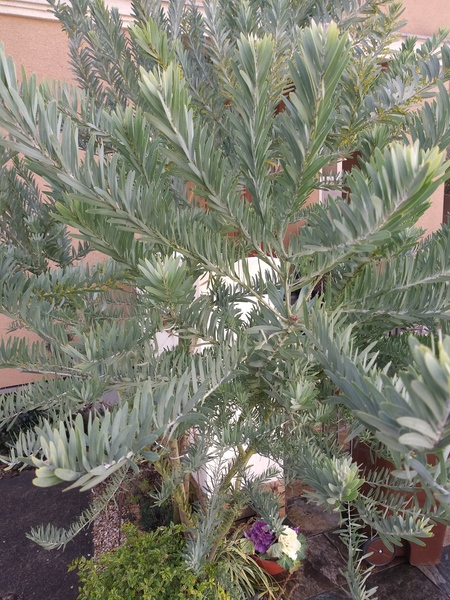
Acacia covenyi (blue bush)
Japanese name: アカシア コベニー
Scientific name: Acacia covenyi
[Overview]
An evergreen shrub or small tree about 6–7.5 m tall.
It is distributed only in Deua National Park, in southeastern New South Wales, Australia.
The twigs are ridged and covered with a whitish bloom.
The leaves are alternate; they are slightly curved, narrowly elliptic to linear phyllodes about 1.5–6 cm long and 0.5–1 cm wide, with a whitish bloom that makes them bluish gray.
The phyllodes have a distinct midrib, a spiny projection at the tip, and entire margins.
At the branch tips it bears inflorescences in which spherical flower heads are further gathered in racemes, carrying many golden flowers.
The fruit is a flat legume with a whitish bloom.
[Cultivation]
Propagate from seed.
To promote germination, soak the seeds after collection in 80°C hot water for 30 minutes, leave them soaking in it for half a day to 2 days, and then sow.
The optimum germination temperature is 20–25°C, and germination begins about 1–3 weeks after sowing.
It prefers a sunny, well-drained place.
In warm regions south of the Kanto region, it can overwinter in the open ground.
It will not flower without enough sun.
Also, strong winds can break the branches and trunk, so avoid places exposed to strong wind.
It tolerates light frost.
Once established, plants need no watering unless the soil becomes extremely dry.
In summer, water in the morning or evening when the temperature is low.
Pruning hard after flowering can lengthen the tree's life.
Transplanting a mature tree is difficult, but if it must be done, root pruning is carried out the previous year.
Pests and diseases include scale insects and aphids.
Details
Japanese: アカシア コベニー、ブルーブッシュ、ブルーブッシュアカシア
Translated from our Japanese encyclopedia. If anything differs, the Japanese page is correct.