
Plant Encyclopedia

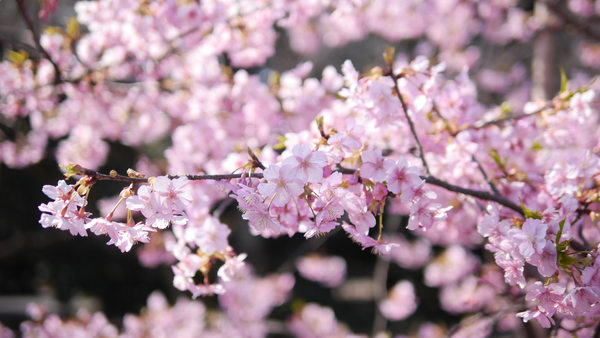
Cerasus ×kanzakura ‘Kawazu-zakura’
Japanese name: 河津桜
Scientific name: Cerasus ×kanzakura ‘Kawazu-zakura’
[Overview]
A horticultural cultivar of the Kanhi-zakura group.
One parent is Kanhi-zakura; the other is unknown, though one theory holds that it is Oshima-zakura.
A deciduous tree.
The bark is purplish brown and glossy.
The leaves are simple and alternate, elliptic to elliptic-obovate, 10–12 cm long and 6–7 cm wide, with a tail-like pointed tip and a base that is usually cordate, sometimes rounded.
The teeth are simple, mixed with some double teeth, and each tooth tip has a small reddish-purple gland.
The leaves are thick and glossy on the upper surface, and slightly whitish on the underside.
The midrib is sometimes tinged with pale reddish purple.
The petiole is about 2 cm long, with 1–2 nectaries at its upper end, and is sometimes tinged with reddish purple.
The flowers are borne 4–5 per corymb from the leaf axils; they are pale reddish purple, 5-petaled, and about 3 cm across.
The petals are round to broadly ovate, with a notch at the tip.
The buds are deep reddish purple.
The earliest flowers open from late January.
The flower stalk is 1–1.3 cm long, and the pedicel is about 2 cm long.
The bracts are small, 1.5–5 mm long.
The calyx tube is reddish purple and tubular-bell-shaped, and the calyx lobes are long-ovate with a few fine teeth.
[History]
In 1955 Iida Katsumi discovered the original tree growing wild in Kawazu, Shizuoka, and it was at first called Komine-zakura after the discoverer's yago (family trade name).
[Cultivation]
Propagate by cuttings or grafting.
It prefers a sunny, well-drained site.
If it would become troublesome by growing into a large tree in a garden, it is good to restrict the space where the roots spread with a fabric pot in order to control the size of the tree.
While it is still a young tree, protect it from frost, for example by laying straw around the base.
Also, it is better not to cut branches needlessly.
It is prone to many pests and diseases, so care is needed.
[Notes]
It is widely planted in Kawazu on the Izu Peninsula and around Irozaki, and has been designated the tree of Kawazu.
Details
Translated from our Japanese encyclopedia. If anything differs, the Japanese page is correct.