EVERGREEN

Plant Encyclopedia

Aloe arborescens

Aloe arborescens (candelabra aloe, "Kidachiaroe")

Japanese name: キダチアロエ
Scientific name: Aloe arborescens

Aloe arborescens

[Overview]
A succulent perennial 1–2 m tall, branching freely and forming clumps.
The leaves form a rosette and are long triangular, 45–60 cm long and 5 cm wide, with dense triangular spines along the margins.
The leaves are gray-green to green.
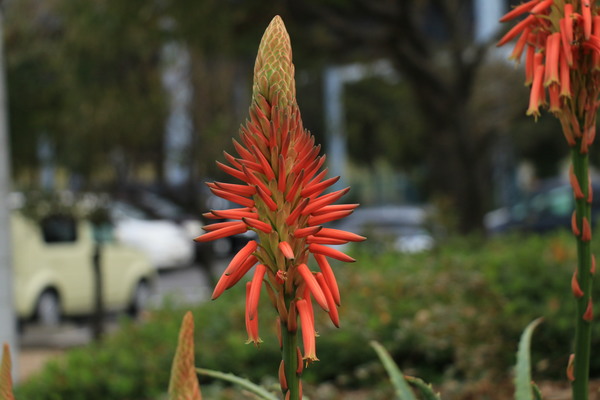
An erect raceme bears many cylindrical, bright red flowers about 4 cm long.

[History]
It was introduced to Japan in the early Meiji era.

[Uses]
Called "ishaira zu" (doctor not needed) and other names, it is used as a folk remedy, with the juice applied to burns and cuts.
It is also eaten raw for stomach and intestinal ailments, and is used in cosmetics and other products.

[Cultivation]
It is easy to grow in a well-drained, sunny place, and can be grown outdoors in warm regions of Japan.
Propagate by cuttings or division.
Pests and diseases include scale insects and aphids.

Details

Names
English: candelabra aloe, octopus plant, torch plant
Japanese: キダチアロエ、キダチロカイ(木立蘆薈)、医者いらず
Life form
Perennial
Evergreen / deciduous
Evergreen
Habit
Terrestrial
Planting (or sowing) season
May, June, July, August, September
Flowering season
January, February, March, December
Distribution or origin
Southeastern Africa (South Africa, Zimbabwe, Mozambique, Malawi)
Growth form
Upright
Height
1000–2000 mm
Leaf shape
Special
Leaf arrangement
Alternate
Leaf margin
Spiny
Inflorescence
Raceme
Number of petals
6
Flower color
Red
Leaf color
Green
Availability of seeds and plants
Low
Form sold
Seedlings
Propagation
Cuttings, Division
Sun exposure
Full sun
Water needs
Moderate
Soil needs
Required
Tolerance
Heat tolerance, Drought tolerance
Suitable uses
Potted plant, Container, Balcony
Pests
Scale insects, Aphids
Edible parts
Leaves
Uses
Edible, Medicinal
Japan Flower Trade Code
50703

Translated from our Japanese encyclopedia. If anything differs, the Japanese page is correct.

Sponsored