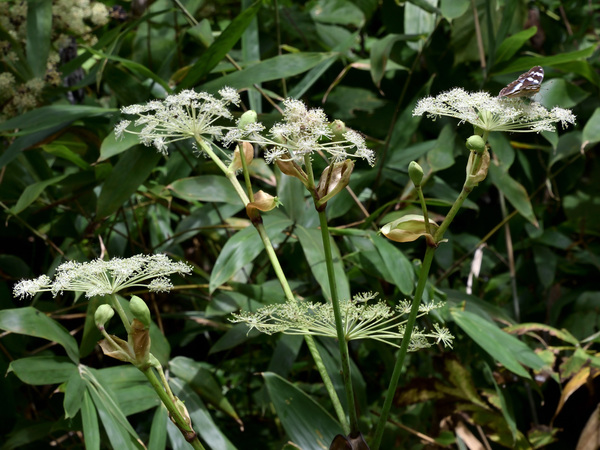
Angelica sachalinensis var. glabra("Michinokuyoroigusa")
Japanese name: ミチノクヨロイグサ(陸奥鎧草) Scientific name:Angelica sachalinensis var. glabra
[Overview]
A perennial found in sunny places such as the edges of forests on low mountains.
The stem grows 1–2 m tall; it is hollow and erect, and branches in the upper part.
Leaves are alternate, 2–3 times ternately pinnately compound; the leaflets are oblong, rather thick in texture, and glossy on the upper surface.
The leaf margins are serrated.
The underside of the leaf is whitish, and there are no hairs even on the veins.
The base of the leaflet often runs down onto the leaf axis.
The leaf stalk is swollen like a sac.
A compound umbel at the stem tip bears many small white five-petaled flowers.
The inflorescence has no involucral bracts, and bractlets are absent or few.
The fruit is an elliptic mericarp.
There are 1–2 oil canals under each dorsal groove and 2–3 on each side of the commissural face.