
Plant Encyclopedia

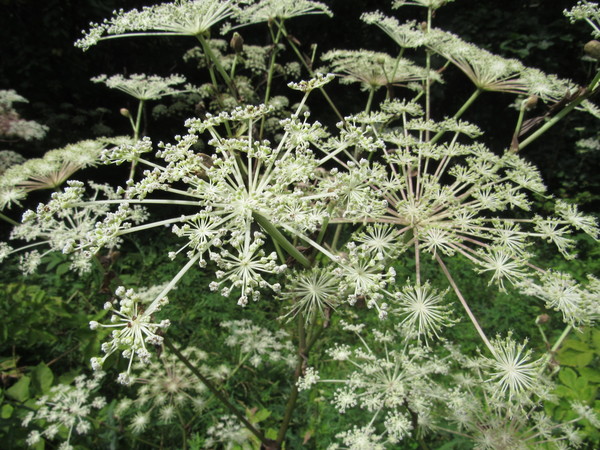
Angelica pubescens var. pubescens ("Shishiudo")
Japanese name: シシウド (猪独活)
Scientific name: Angelica pubescens var. pubescens
[Overview]
A perennial found in slightly moist places such as mountain slopes, sunny grasslands and forest edges.
It flowers and fruits in its 4th–5th year and then dies, so it is also called a monocarpic herb.
The stem grows 1–2 m tall; it is thick, hollow and erect, and branches in the upper part.
The stem and leaves have fine hairs.
Leaves are alternate, 2–3 times ternately pinnately compound; the leaflets are oblong and have serrated margins.
The base of the terminal leaflet lobe runs down onto the leaf axis.
The leaf stalk is swollen like a sac.
A compound umbel at the stem tip bears many small white five-petaled flowers.
The inflorescence has neither involucral bracts nor bractlets.
The fruit is a broadly elliptic mericarp.
[Uses]
The root is used medicinally.
[Cultivation]
Propagate from seed.
It prefers fertile, sunny, well-drained sites.
Plant out with about 30 cm between plants, and apply a small amount of organic fertilizer such as chicken manure or oil cake.
Water when the soil dries, and in midsummer water in the morning and evening when temperatures are lower.
Excess moisture causes root rot.
During the rainy season, take care, for example by making ditches for drainage.
There are no particular pests or diseases.
Details
Translated from our Japanese encyclopedia. If anything differs, the Japanese page is correct.