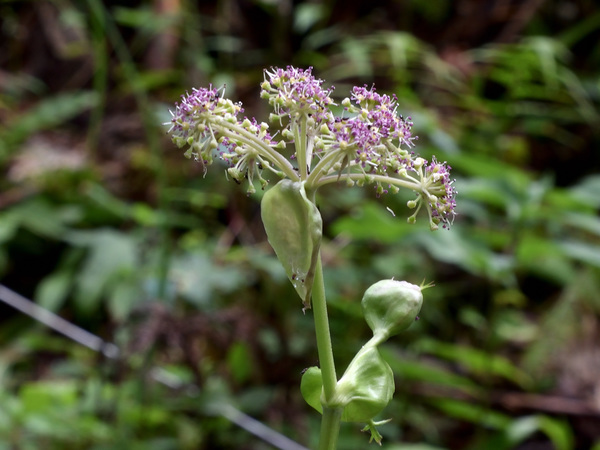
Japanese name: ノダケ(野竹) Scientific name:Angelica decursiva
[Overview]
A perennial 0.8–1.5 m tall, found at the edges of woods in hills and fields.
The stem is erect, branches in the upper part, and is tinged dark purple.
The leaves are alternate and ternately pinnately compound; the leaflets are oblong to long-ovate, with serrated margins.
The base of the terminal lobe of each leaflet runs down the rachis.
The leaf stalks are inflated like a sac.
Compound umbels at the stem tips bear many small dark purple 5-petaled flowers.
The fruit is a broadly oblong schizocarp.
[Uses]
The root is called zenko and is used as a Chinese herbal medicine.
[Cultivation]
Propagate from seed.
It prefers a sunny, well-drained site.
For potted plants, water thoroughly when the soil surface dries; for plants in the ground, rainfall is sufficient.
If fertilizer is applied at planting, no further fertilizing is particularly necessary.
There are no particular pests or diseases.