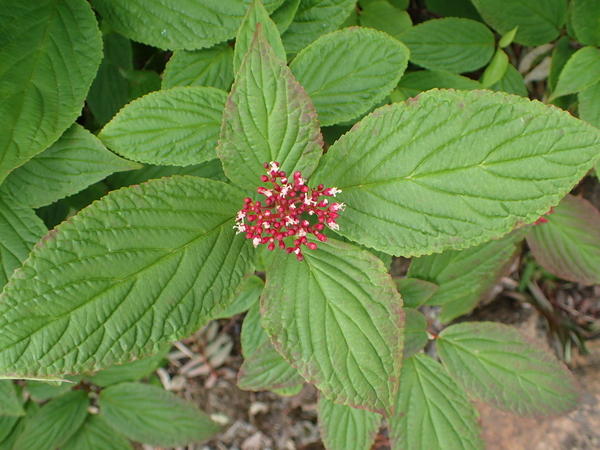
Viburnum urceolatum f. procumbens("Miyamashigure")
Japanese name: ミヤマシグレ(深山時雨) Scientific name:Viburnum urceolatum f. procumbens
[Overview]
A deciduous shrub about 0.5 m tall, found in the mountains.
The lower part of the stem creeps along the ground and produces roots.
Young branches are at first covered with stellate hairs.
The leaves are simple and opposite, ovate.
There are 4–6 pairs of lateral veins, which curve in an arch and form a net-like pattern near the margin.
The leaf margin is toothed or almost entire.
The petiole is covered with stellate hairs.
A corymb 2.5–6 cm across is borne at the branch tips; the inflorescence stalk is usually red and sparsely covered with stellate hairs.
The flowers hardly open and are tubular, 0.2–0.3 cm across, with a conspicuous crimson calyx tube.
The stamens project from the flower tube.
The fruit is spherical, 0.6–0.8 cm long, red at first, then ripening to black.