
Plant Encyclopedia

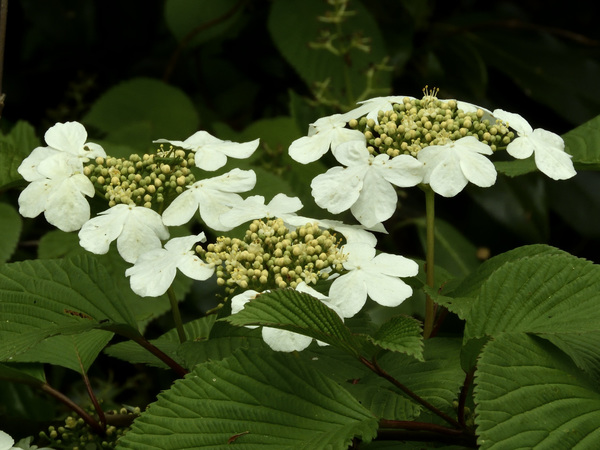
Viburnum plicatum var. tomentosum ("Yabudemari")
Japanese name: ヤブデマリ (藪手毬)
Scientific name: Viburnum plicatum var. tomentosum
[Overview]
A deciduous shrub or small tree 2–6 m tall, found in hills and mountains.
The branches spread horizontally.
Young branches have 4 ridges and are densely covered with brown stellate hairs.
The leaves are simple and opposite, elliptic to obovate, 5–12 cm long and 3.5–7 cm wide, with dense stellate hairs on the lower surface.
There are 7–12 pairs of lateral veins, which run almost straight, and the margin is toothed.
The petiole is 1.2–2.5 cm long and densely covered with stellate hairs; there are no stipules.
At the branch tips, a flat corymb 5–10 cm across is borne together with a pair of leaves.
Several ornamental flowers are borne around the edge of the inflorescence.
The ornamental flowers are white, 2–4 cm across; the corolla is unevenly 5-lobed, and one of the lobes is very small.
The bisexual flowers in the center of the inflorescence are cream to white, 3.5–5 mm across, with a 5-lobed corolla.
The fruit is 5–6.5 mm long, red at first, then ripening to black.
When in fruit, the inflorescence stalk turns red.
[Cultivation]
Propagate from seed or by cuttings.
For seed, collect ripe fruits, wash off the pulp thoroughly, and then sow.
It grows well regardless of soil type in a sunny or partially shaded, well-drained place rich in humus.
For potted plants, water thoroughly when the soil surface dries; for plants in the ground, rainfall is sufficient unless summer brings a long spell of sunny weather and the soil becomes severely dry.
Apart from fertilizer in winter, apply a slow-release chemical fertilizer with equal amounts of the three components after flowering as a thank-you fertilizer.
Do not prune, and enjoy the natural tree shape; if you want to keep it compact, cut just above a bud as early as possible after flowering.
Poor ventilation makes powdery mildew and scale insects likely to occur, so care is needed.
Details
Translated from our Japanese encyclopedia. If anything differs, the Japanese page is correct.