
Plant Encyclopedia

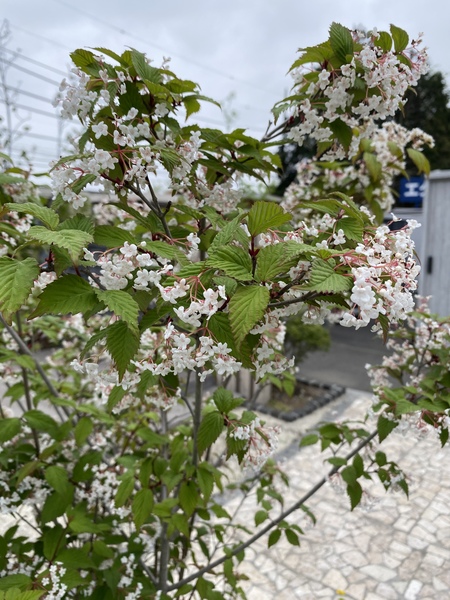
Viburnum phlebotrichum ("Otokoyozome")
Japanese name: オトコヨウゾメ
Scientific name: Viburnum phlebotrichum
[Overview]
A deciduous shrub about 1–3 m tall, growing in forests and at forest edges.
It branches well.
Young branches are tinged with red.
Leaves are simple and opposite, ovate, 2–9 cm long and 1.5–5 cm wide.
The veins on the underside have long appressed hairs, and there are 5–8 pairs of lateral veins running parallel.
The leaf margin has coarse triangular teeth.
The base of the underside has 1–3 glandular dots.
The petiole is 0.3–1 cm long and tinged with purple, and there are no stipules.
The leaves turn black when dried.
At the branch tips, corymbs 1–6 cm across are produced, and the base of the inflorescence has 1 pair of leaves.
The inflorescence often hangs down.
The flowers are white, 0.6–0.9 cm across, and the corolla is 5-lobed.
The fruit is spherical to elliptical, 0.5–1 cm long, ripens red, and is glossy.
[Cultivation]
Propagate from seed, cuttings, or layering.
For seed, collect ripe fruit, wash off the pulp thoroughly, and then sow.
It prefers partial shade and fertile, well-drained soil that is moderately moist.
For potted plants, water thoroughly when the soil surface dries; for plants in the ground, rainfall is sufficient unless summer brings a long spell of sunny weather and the soil becomes dry.
Apply fertilizer in winter, and also apply a slow-release chemical fertilizer with equal amounts of the three components after flowering as a thank-you fertilizer.
No pruning is done and the natural shape is enjoyed.
There are no particular pests or diseases.
Details
Translated from our Japanese encyclopedia. If anything differs, the Japanese page is correct.