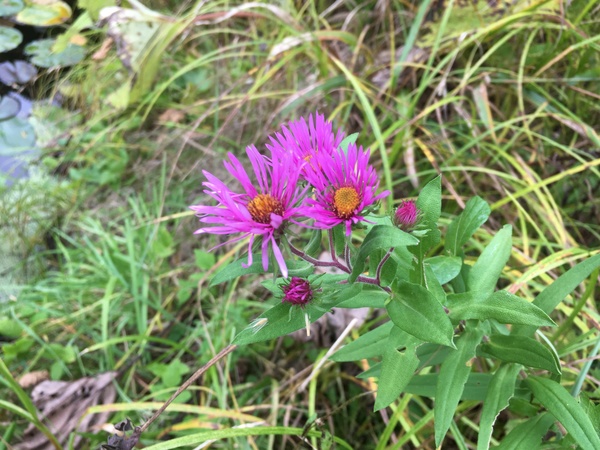
Symphyotrichum novae-angliae(New England aster, "Nebarinogiku")
Japanese name: ネバリノギク(粘野菊) Scientific name:Symphyotrichum novae-angliae
[Overview]
A perennial about 0.3–1.2 m tall, found along roadsides and similar places.
The stem has white hairs, mixed with glandular hairs in the upper part.
There are basal leaves and leaves on the stem; the basal leaves have often withered by the flowering season.
The leaves on the stem are simple and alternate, linear-oblong to ovate-lanceolate, 6–8 cm long and 1–1.5 cm wide, with short hairs and glandular hairs on both sides.
The leaf base clasps the stem in an ear-like shape.
Many flower heads 3–3.5 cm across are borne at the stem tip.
The flower heads consist of ray florets and tubular florets; there are 60–110 ray florets, usually reddish purple.
The involucral bracts are all reflexed.
The flower head stalks and involucral bracts are densely covered with glandular hairs and are sticky.
The fruit is an achene with a pappus.
[History]
It was introduced for ornamental use in the Taisho era and has become naturalized in many places.
[Notes]
It is designated an Invasive Alien Species Requiring Caution under the Invasive Alien Species Act.
It has also been selected as one of the 100 worst invasive alien species of Japan.