
Plant Encyclopedia

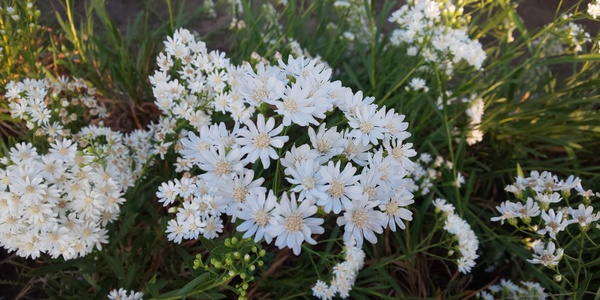
Solidago ptarmicoides (prairie aster, "Teriatsubagiku")
Japanese name: テリアツバギク (照厚葉菊)
Scientific name: Solidago ptarmicoides
[Overview]
A perennial 30–60 cm tall.
In its native range it is found on dry sandy ground, in calcareous soil, in cracks in limestone, and in grasslands.
The leaves include basal leaves and stem leaves.
The stem leaves are simple and alternate; those on the lower part of the stem are linear to linear-lanceolate, 6–10 cm long and 0.7–1 cm wide, relatively thick and hard, with entire margins or very shallow teeth, and have leaf stalks.
The leaves on the upper part of the stem are small and have no leaf stalks.
At the branch tips, 3–25 flower heads 1.2 cm across, sometimes as many as 50, are borne in a flat corymb.
The ray flowers are white, 10–20 per flower head, and the tubular flowers are white to cream.
The fruit is an achene with a pappus.
Details
Japanese: テリアツバギク(照厚葉菊)
Translated from our Japanese encyclopedia. If anything differs, the Japanese page is correct.