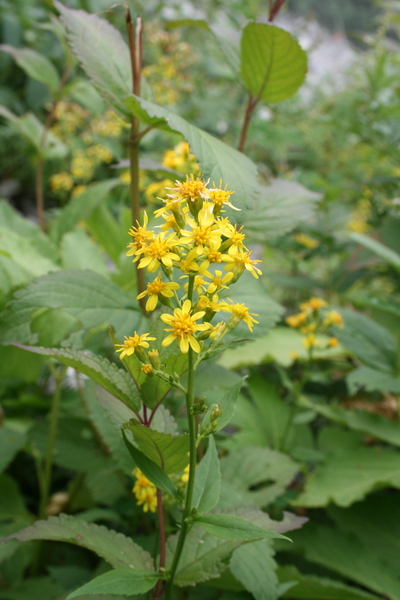
Solidago virgaurea subsp. leiocarpa var. leiocarpa f. japonalpestris
Solidago virgaurea subsp. leiocarpa var. leiocarpa f. japonalpestris("Miyamaakinokirinso")
Japanese name: ミヤマアキノキリンソウ(深山秋麒麟草) Scientific name:Solidago virgaurea subsp. leiocarpa var. leiocarpa f. japonalpestris
[Overview]
A perennial 15–60 cm tall, found in sunny grasslands and similar places from the subalpine to the alpine zone.
The leaves include basal leaves and stem leaves, and the basal leaves sometimes remain at flowering time.
The basal leaves have long leaf stalks.
The stem leaves are simple and alternate; those on the lower part of the stem are ovate to lanceolate, with toothed margins, and have leaf stalks.
The leaf stalks are winged.
At the branch tips, yellow flower heads 1.2–1.5 cm across are borne densely; both the ray flowers and the tubular flowers are yellow.
There are 10 or more ray flowers per flower head.
The involucral bracts are in 3 rows.
The fruit is an achene with a pappus.
[Cultivation]
Propagate by division.
It prefers well-drained soil.
A sunny place is suitable from autumn to spring, and a cool, airy place in partial shade in summer.
For plants in the ground, it is good to plant them under deciduous trees.
For potted plants, water thoroughly when the soil surface dries; for plants in the ground, rainfall is sufficient unless summer brings a long spell of sunny weather and the soil becomes severely dry.
Apply slow-release fertilizer in spring when the shoots emerge and after flowering.
Pests and diseases include powdery mildew, rust, leaf miners, goldenrod lace bugs, spider mites and aphids.