
Plant Encyclopedia

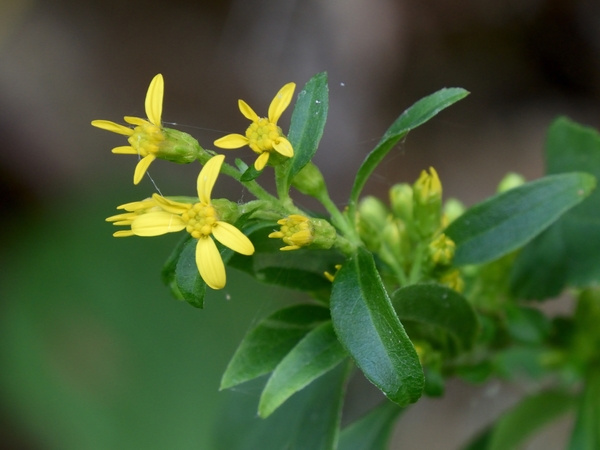
Solidago virgaurea subsp. asiatica var. asiatica ("Akinokirinso")
Japanese name: アキノキリンソウ (秋麒麟草)
Scientific name: Solidago virgaurea subsp. asiatica var. asiatica
[Overview]
A perennial 35–80 cm tall, commonly found in sunny mountains and grasslands.
The leaves include basal leaves and stem leaves, and the basal leaves have withered by flowering time.
The basal leaves have long leaf stalks.
The stem leaves are simple and alternate; those on the lower part of the stem are ovate to lanceolate, 7–9 cm long and 1.5–5 cm wide, with toothed margins, and have leaf stalks.
The leaf stalks are winged.
The leaves on the upper part of the stem are lanceolate and have no leaf stalks.
At the branch tips, yellow flower heads 1.2–1.4 cm across are borne in corymbs to racemes; both the ray flowers and the tubular flowers are yellow.
There are 10 or fewer ray flowers per flower head.
The involucral bracts are in 4 rows.
The fruit is an achene with a pappus.
[Uses]
The whole plant is used medicinally.
[Cultivation]
Propagate by division.
It prefers sunny, well-drained soil.
It is cold-hardy and heat-tolerant, sturdy and easy to grow.
For potted plants, water thoroughly when the soil surface dries; for plants in the ground, rainfall is sufficient unless summer brings a long spell of sunny weather and the soil becomes severely dry.
If a basal fertilizer is applied, no further fertilizer is particularly necessary; too much can make the plant leggy and cause it to fall over.
When the plant becomes tall, it is good to set up stakes to keep it from falling over.
Pests and diseases include powdery mildew, rust, leaf miners, goldenrod lace bugs, spider mites and aphids.
Details
Translated from our Japanese encyclopedia. If anything differs, the Japanese page is correct.