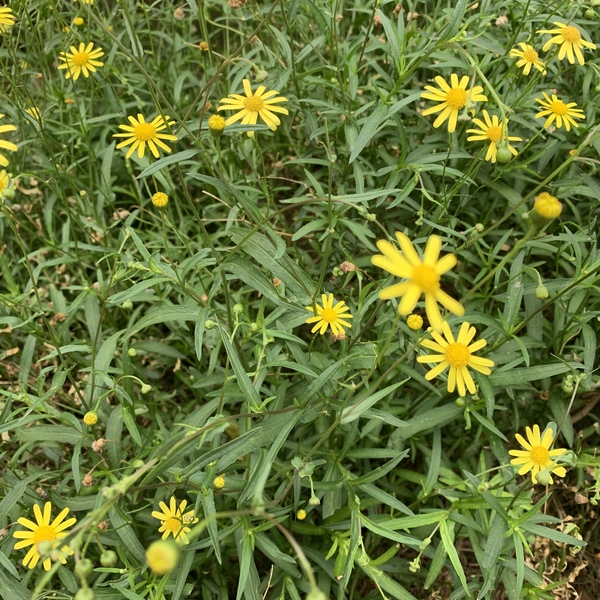
Japanese name: ナルトサワギク(鳴門沢菊) Scientific name:Senecio madagascariensis
[Overview]
An annual or perennial 20–70 cm tall, found mainly on reclaimed land, vacant lots, roadsides and similar places.
The stem branches freely from ground level and forms a large clump.
The leaves are alternate, lanceolate, 3–9 cm long and 1–1.5 cm wide, and are either pinnately divided or undivided and simple.
The leaf margins have a few low teeth.
The leaf base slightly clasps the stem.
It flowers all year round, bearing a few yellow flower heads, 2–2.5 cm across, in corymbs on the upper part of the stem.
The flower heads consist of ray florets and tubular florets; there are usually 13 ray florets.
The involucre is 0.5–0.8 cm long, with the involucral bracts in 1 row and a few small supplementary bracts.
The achene is 0.2 cm long and has a white pappus.
[History]
It was discovered in Naruto, Tokushima, in 1976.
[Notes]
It is designated a "Specified Invasive Alien Species" under the Invasive Alien Species Act.
It contains alkaloids and is toxic to herbivores, so there is a risk of poisoning in livestock.