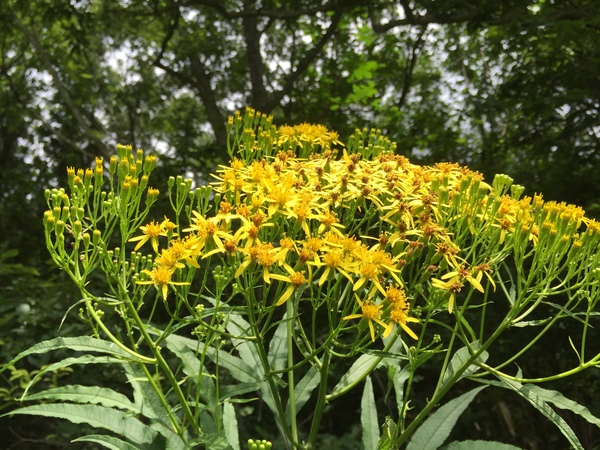
Japanese name: ハンゴンソウ(反魂草) Scientific name:Senecio cannabifolius
[Overview]
A perennial 1–2 m tall, found in grassland in the mountains and similar places.
The stem branches in the upper part.
There are basal leaves and stem leaves; the basal leaves have withered by flowering time.
The leaves on the stem are simple and alternate, 10–20 cm long and 9–15 cm wide, deeply pinnately divided or divided all the way to the midrib, with 1–2 pairs of lobes.
The leaf margins are toothed.
There are two small ear-like projections at the base of the petiole.
Many yellow flower heads, about 2 cm across, are borne in corymbs on the upper part of the stem.
Each flower head has 5–7 ray florets around the edge and tubular florets in the center.
The involucre is cylindrical, about 5 mm long, with small linear bracts at the base.
The achene is 3 mm long and has a yellowish white to pale brown pappus.
[Uses]
The young shoots in spring are strongly bitter, but are used as a wild vegetable.
[Notes]
There are theories about the origin of the Japanese name: one says the appearance of the leaves was likened to a ghost's hand, and another says the name was mistakenly applied to Liu Jinu, a medicinal herb said in China to have the power to bring the dead back to life.
Japan (Hokkaido, Honshu central part and northward), Korea, northeastern China, eastern Siberia, Kamchatka Peninsula, Sakhalin, Kurils, Aleutian Islands
Height
1000–2000 mm
Leaf shape
Lobed leaf
Leaf arrangement
Alternate, Basal
Leaf margin
Serrate
Inflorescence
Head
Flower color
Yellow
Leaf color
Green
Edible parts
Leaves
Uses
Edible
Translated from our Japanese encyclopedia. If anything differs, the Japanese page is correct.