
Plant Encyclopedia

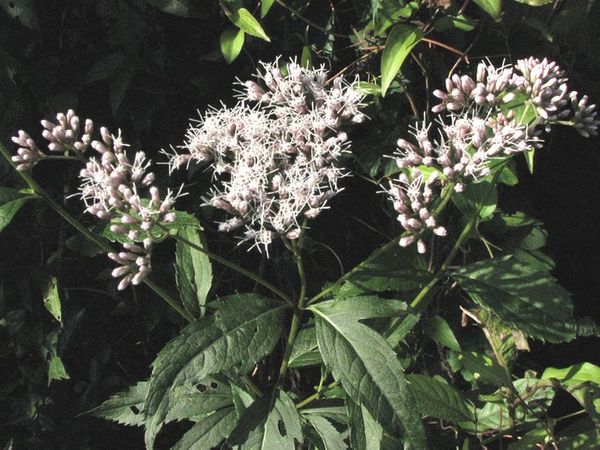
Eupatorium japonicum ("Fujibakama")
Japanese name: フジバカマ (藤袴)
Scientific name: Eupatorium japonicum
[Overview]
A perennial 1–2 m tall, found in moist grassland on riverbanks.
It has a rhizome that creeps long horizontally and branches, and it often grows in colonies.
The stem is green, erect, branches in the upper part, and is hairless or slightly hairy.
The leaves are opposite and 8–13 cm long; those on the lower part of the stem are deeply 3-lobed, while those on the upper part are usually undivided in wild plants.
The upper surface of the leaves is glossy and hairless, or sparsely covered with short hairs along the margin.
The underside of the leaves is hairless or sparsely covered with short hairs on the veins, and has no glandular dots.
The leaf margins are serrated.
The leaves have short petioles.
Many pale reddish purple to pale purple flower heads are borne in corymbs at the top of the stem.
The flower heads consist only of tubular flowers, and the pistils protrude from the flowers.
The flowers have a strong fragrance.
The fruit is an achene with a white pappus.
[History]
Long loved as one of the Seven Herbs of Autumn, it appears in the Man'yoshu and The Tale of Genji.
It is presumed to have been brought from the continent during the Nara period and to have become naturalized.
[Uses]
The dried stems and leaves are fragrant, and the whole plant is used medicinally and in bath additives.
[Cultivation]
Propagate from seed, by division, or by stem cuttings.
It prefers a sunny site with soil that is both well drained and moisture-retentive.
When planting in the ground, avoid places that get strong afternoon sun or that dry out.
Because it spreads by extending its underground stems, to keep it from spreading too much, make a frame underground or plant it in a large pot and bury the pot.
Take care that it does not run short of water; for potted plants, water thoroughly when the soil surface dries, and for plants in the ground, rainfall is sufficient unless summer brings a long sunny spell and the soil dries out.
Too much fertilizer makes the plant leggy and reduces flowering, so apart from basal fertilizer none is particularly needed, but for potted plants diluted liquid fertilizer may be given in spring and autumn.
There are no particular pests or diseases.
[Notes]
It is designated Near Threatened, but in some places cultivated plants have escaped and become established.
Details
Translated from our Japanese encyclopedia. If anything differs, the Japanese page is correct.