
Plant Encyclopedia

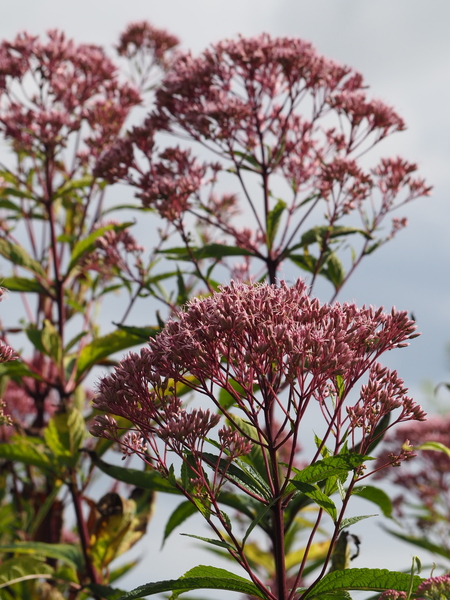
Eupatorium maculatum (spotted joe-pyeweed)
Japanese name: ユーパトリウム マクラツム
Scientific name: Eupatorium maculatum
[Overview]
A perennial 2–3 m tall, found in its native range in moist grasslands, pastures and wetlands.
It has rhizomes and forms large clumps.
The stem is green with purple spots or entirely purple, erect, and branches in the upper part.
The leaves are simple, usually in whorls of 5, lanceolate and about 30 cm long, with serrate margins.
The petioles are short.
Many pale reddish purple to pale purple flower heads are borne in corymbs at the top of the stem.
The flower heads consist only of tubular flowers, and the styles protrude out of the flowers.
The fruit is an achene with a white pappus.
[Uses]
The whole plant is used medicinally.
[Cultivation]
Propagate from seed, by division, or by stem cuttings.
The seeds need light to germinate, so cover them with only a very thin layer of soil and water from below.
It prefers a sunny site with soil that is well drained and retains water well.
When planting in the ground, avoid places exposed to strong afternoon sun or places that become dry.
For plants in the ground, rainfall is sufficient unless summer brings a long spell of sunny weather and the soil becomes dry.
Too much fertilizer makes the plant leggy and reduces flowering, so no fertilizer is particularly needed if basal fertilizer is applied.
There are no particular pests or diseases.
Details
Japanese: ユーパトリウム マクラツム
Translated from our Japanese encyclopedia. If anything differs, the Japanese page is correct.