
Plant Encyclopedia

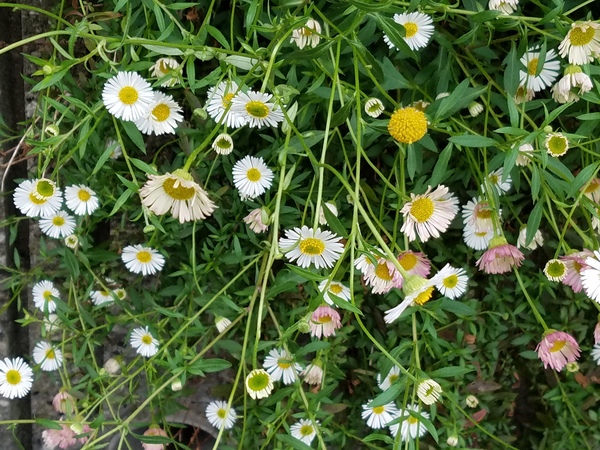
Erigeron karvinskianus (Mexican fleabane, "Peraperayomena")
Japanese name: ペラペラヨメナ
Scientific name: Erigeron karvinskianus
[Overview]
A perennial 20–40 cm tall.
It is evergreen in warm regions.
The stems branch well from the base and spread in a mat, with the upper parts rising upright.
The leaves are alternate; those on the lower part of the stem are 3–5-lobed and have petioles.
The leaves on the upper part of the stem are lanceolate, with entire margins and no petioles.
The leaves are hairy and look grayish.
A single flower head 1.5–2 cm across is borne at the end of each branch.
The flower heads have a single row of ray florets around yellow tubular florets, but the ray florets are white at first and gradually turn pale pink, so red and white flowers bloom mixed on the same plant.
The fruit is an achene with a pappus.
[History]
Introduced as an ornamental and for greening, it was confirmed to be naturalized in Kyoto in 1949 and in Kanazawa in 1952, and it has since become wild in many regions.
[Cultivation]
Propagate from seed, by division, or by shoot cuttings.
It also spreads readily from self-sown seed.
It grows well in any soil as long as the site is sunny and well drained.
If the conditions suit it, it grows well even when left alone.
Take care not to let it become too humid when watering; for potted plants, water thoroughly after the soil has dried, and for plants in the ground, rainfall is sufficient.
If basal fertilizer is applied, no further fertilizing is particularly necessary, but for potted plants a small amount of slow-release fertilizer may be applied in spring and autumn.
If it overgrows and the plant's shape becomes untidy, cut it back hard in late autumn.
There are no particular pests or diseases, but gray mold and powdery mildew may appear in humid conditions.
Details
Japanese: ペラペラヨメナ、ペラペラヒメジョオン、メキシコヒナギク、ゲンペイコギク(源平小菊)
Translated from our Japanese encyclopedia. If anything differs, the Japanese page is correct.