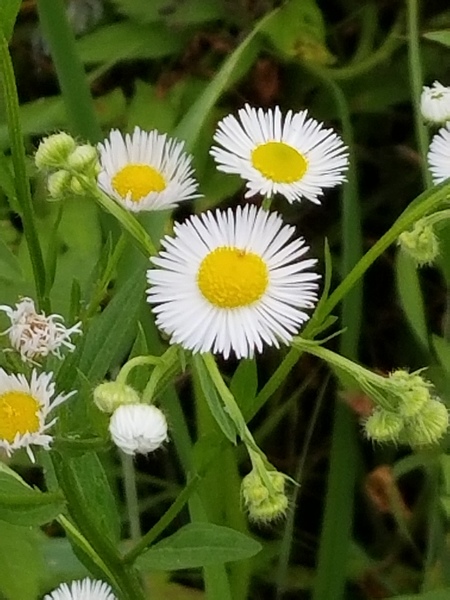
Japanese name: ヒメジョオン(姫女苑) Scientific name:Erigeron annuus
[Overview]
An annual or biennial 30–150 cm tall, found along roadsides, in vacant lots and in fields.
The stem is erect and not hollow.
There are both basal leaves and stem leaves; the basal leaves are ovate with toothed margins and long petioles, and have withered by flowering time.
The leaves on the stem are simple and alternate, ovate to lanceolate, with sparse teeth on the margins.
The bases of the stem leaves do not clasp the stem.
The stem branches in the upper part and bears many flower heads about 2 cm across.
There are about 100 ray florets, linear and white to pale purple.
The tubular florets are yellow.
The fruit is an achene with a pappus.
[History]
It arrived in Japan at the beginning of the Meiji era and has become naturalized in many regions.
[Notes]
It resembles Harujion, but can be distinguished by its stem not being hollow, its buds not drooping, and the number of its ray florets.