
Plant Encyclopedia

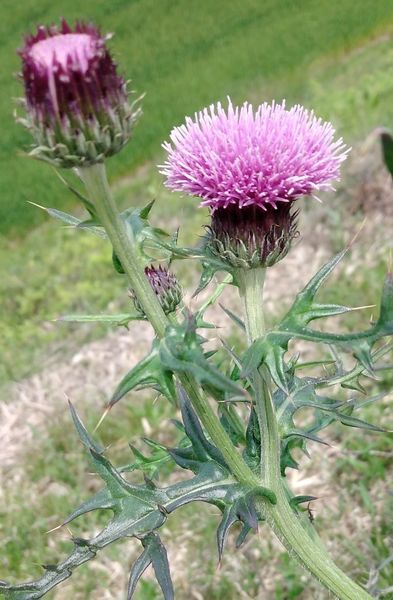
Cirsium japonicum subsp. japonicum var. japonicum ("Noazami")
Japanese name: ノアザミ (野薊)
Scientific name: Cirsium japonicum subsp. japonicum var. japonicum
[Overview]
A perennial 50–200 cm tall, found in sunny grasslands and on embankments in hills and mountains.
It is said that some plants on Tobishima in Yamagata reach 3 m in height.
The root is not thickened into a spindle shape but is thick and cord-like.
The stem is erect and branches in the upper part.
There are basal leaves and stem leaves; the basal leaves usually remain even at the flowering season.
The basal leaves are narrowly ovate to narrowly elliptic, 15–40 cm long and 4–10 cm wide, pinnately divided into 5–6 pairs of lobes, with spines on the margins.
The stem leaves are alternate, without leaf stalks, and clasp the stem broadly at the base.
The flower heads are borne facing upward at the stem tip, solitary or in groups of 2–5, and are pale reddish purple.
White-flowered plants are occasionally found.
The involucre is bell-shaped, 1.5–2 cm wide, and the involucral bracts are in 6–9 rows.
All the involucral bracts have glands and are sticky.
The fruit is an achene with a white pappus.
[Uses]
The young stems and leaves and the roots can be eaten.
The whole plant is used medicinally.
[Cultivation]
Propagate from seed or by division.
It prefers a sunny, well-drained, well-ventilated site.
When planting in the ground, avoid places that become extremely dry.
For potted plants, water thoroughly when the soil surface dries; for plants in the ground, rainfall is sufficient unless summer brings a long spell of sunny weather and the soil becomes severely dry.
For plants in the ground, no fertilizer is particularly necessary if base fertilizer is applied, and too much may produce only leaves and make flowering difficult.
For potted plants, a small amount of slow-release fertilizer may be applied from spring to autumn, depending on how the plant is growing.
When the plant grows tall, it is best to set up a stake so that it does not fall over.
There are no particular pests or diseases, but powdery mildew and aphids may occur.
[Notes]
This is the thistle most commonly seen in Japan, blooming from spring to early summer.
Occasionally plants still in bloom in autumn can be seen.
Details
Translated from our Japanese encyclopedia. If anything differs, the Japanese page is correct.