
Plant Encyclopedia

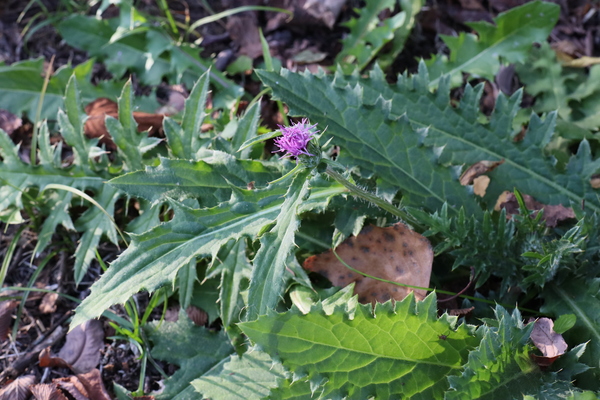
Cirsium aidzuense ("Aizuhimeazami")
Japanese name: アイヅヒメアザミ (会津姫薊)
Scientific name: Cirsium aidzuense
[Overview]
A perennial growing at the edges of deciduous forests in the mountains, and also found on cold-air vent sites and serpentine areas.
It is a limestone plant or ultramafic rock plant.
It is a thistle endemic to Fukushima, Tochigi and Gunma.
The stem is erect or leans under the weight of the inflorescence, reaches 1–2 m tall, and branches freely in the upper part, with branches spreading at wide angles.
The stem has multicellular soft hairs and cobwebby hairs.
There are basal leaves and stem leaves; the basal leaves have withered by flowering time.
The stem leaves are alternate, lanceolate to broadly ovate, 18–45 cm long and 8–25 cm wide.
The leaves are either pinnately divided into 4–5 pairs of lobes, or undivided with serrated or entire margins, and are hairless on both sides.
The leaf base spreads out like ears and clasps the stem.
Several flower heads are borne in a raceme at the stem tip.
The flower heads are about 2–3 cm across, pale reddish purple to reddish purple, and face upward or obliquely upward on slender stalks 3–13 cm long.
The involucre is cylindrical to bell-shaped cylindrical, about 1 cm wide, and the involucral bracts, which are appressed or ascending, are arranged in 11–12 rows (8–9 rows).
The inner and middle involucral bracts have glands and are slightly sticky.
The fruit is an achene with a pappus.
Details
Translated from our Japanese encyclopedia. If anything differs, the Japanese page is correct.