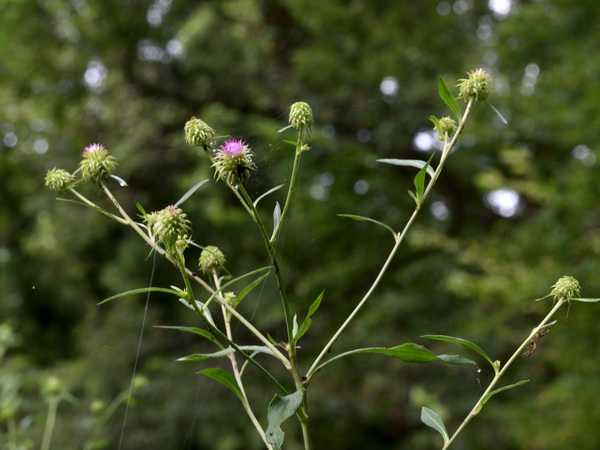
Japanese name: ダキバヒメアザミ(抱葉姫薊) Scientific name:Cirsium amplexifolium
[Overview]
A perennial 1.2–2 m tall, found at forest edges and in grasslands in the mountains.
The stem is erect and branches freely in the upper part.
The stem is almost hairless, but brown hairs grow on the upper part.
There are basal leaves and stem leaves; the basal leaves and the lower stem leaves have withered by flowering time.
The stem leaves are alternate; the middle leaves are elliptic to spoon-shaped, 10–40 cm long and 3–13 cm wide.
The leaves are either pinnately divided into 1–6 pairs of lobes, or undivided with serrated margins.
The leaf base usually forms ear-like lobes that clasp the stem, but some leaves have a short petiole.
Three to seven reddish-purple flower heads are borne in a raceme or singly at the stem tip, blooming obliquely upward to erect.
The flower head stalk is 1–10 cm long and bears 1–2 linear bracts 1–4 cm long.
The involucre is bell-shaped, 1–1.7 cm wide, and the involucral bracts, which are ascending or spreading, are arranged in 8–9 rows.
The inner involucral bracts have glands but are not sticky.
The fruit is an achene with a white pappus.