
Plant Encyclopedia

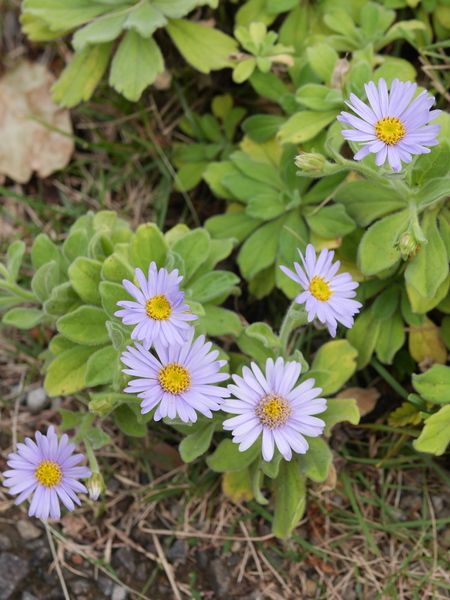
Aster spathulifolius ("Darumagiku")
Japanese name: ダルマギク (達磨菊)
Scientific name: Aster spathulifolius
[Overview]
A perennial found on rocky places along the coast.
It has a rhizome.
The stem branches freely from the base.
There are basal leaves and stem leaves; the basal leaves have withered by flowering time.
The stem leaves are simple and alternate, arranged in rosettes on the non-flowering branches; they are broadly spoon-shaped, 3–9 cm long and 1.5–5.5 cm wide, thick, and densely covered on both surfaces with glandular hairs, giving a velvety look.
The leaf margin is entire or has blunt teeth.
The leaves become smaller toward the top of the stem.
The flowering branches grow 20–40 cm tall and are densely covered with glandular hairs and long soft hairs.
A single flower head is borne facing upward at the branch tip.
The flower head is 3.5–4 cm across, with pale purple, sometimes white, ray florets and yellow tubular florets in the center.
The involucre is 7–10 mm long, and the involucral bracts are in 3 rows and covered with glandular hairs and long soft hairs.
The achene is oblong, 3.5 mm long, and hairy; the pappus is 4–5 mm long.
[Uses]
The aboveground parts are used medicinally.
[Cultivation]
Propagate from seed, by division, or by stem cuttings.
It prefers sunny, well-drained soil.
For potted plants, water thoroughly when the soil surface dries; for plants in the ground, rainfall is sufficient unless summer brings a long spell of sunny weather and the soil dries out.
Besides basal fertilizer, place slow-release chemical fertilizer on the soil in spring and autumn.
If you do not intend to collect seed, remove spent flowers promptly when flowering is over.
Pests and diseases include powdery mildew, slugs, cutworms and aphids.
[Notes]
Outside the flowering season the stems are short and the leaves are dense, giving it a squat, stocky look; the Japanese name is said to come from likening it to a daruma (a round, squat doll).
Details
Translated from our Japanese encyclopedia. If anything differs, the Japanese page is correct.