
Plant Encyclopedia

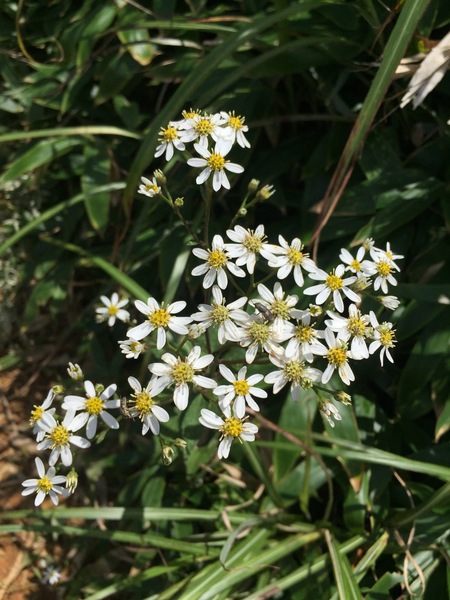
Aster scaber ("Shirayamagiku")
Japanese name: シラヤマギク (白山菊)
Scientific name: Aster scaber
[Overview]
A perennial 1–1.5 m tall, found along roadsides and in grasslands in the mountains.
The stem is erect and branches in the upper part.
There are basal leaves and stem leaves; the basal leaves are ovate-cordate and have withered by flowering time.
The leaves on the lower part of the stem are simple and alternate, ovate-cordate, 6–20 cm long and 6–12 cm wide, with teeth on the margin.
Both leaf surfaces are densely covered with short hairs and are rough.
The winged petiole is 5–20 cm long.
The leaves become smaller and the petioles shorter toward the top of the stem.
Flower heads are borne in corymbs in the upper part of the stem.
The flower heads are about 1.8–2.4 cm across, with 5–10 white ray florets.
The involucre is 4–5 mm long, and the involucral bracts are in 3 rows.
The flower stalk is 1–3 cm.
The achene is oblanceolate-oblong, 3–3.5 mm long, and hairy; the pappus is 3.5–4 mm long.
[Uses]
The young shoots and leaves are eaten, and the whole plant is used medicinally.
[Cultivation]
Propagate by division or stem cuttings.
It prefers well-drained, moderately moist soil and a place in sun to partial shade, out of the afternoon sun.
The roots are damaged in very wet places, but if it becomes too dry in summer, brown spots appear on the leaves and it may wither.
It is hardy, and if the environment suits it, it grows well even when left alone.
Apply slow-release chemical fertilizer around the base of the plant twice a year, in spring when the shoots emerge and after flowering.
Pests and diseases include root rot, powdery mildew, cutworms and aphids.
Details
Translated from our Japanese encyclopedia. If anything differs, the Japanese page is correct.