
Plant Encyclopedia

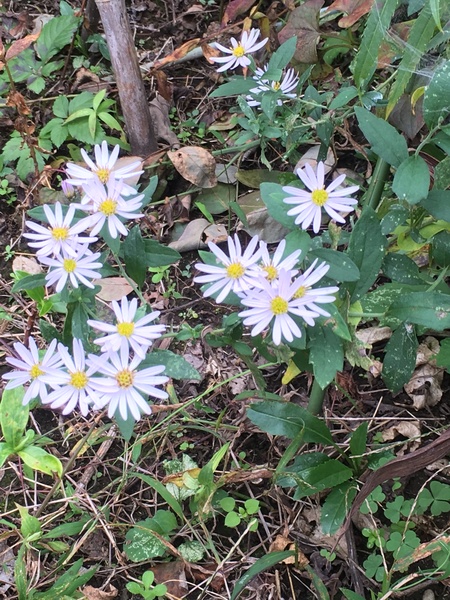
Aster microcephalus var. ovatus ("Nokongiku")
Japanese name: ノコンギク (野紺菊)
Scientific name: Aster microcephalus var. ovatus
[Overview]
A perennial 30–100 cm tall, commonly found in hills and fields.
It has long creeping underground stems.
The stem branches well and has short hairs.
There are basal leaves and stem leaves; the basal leaves are oblong with a petiole and have withered by flowering time.
The stem leaves are simple and alternate, ovate to elliptic, 6–12 cm long and 3–5 cm wide, with 3 conspicuous veins.
Both surfaces of the leaves have short hairs and are rough to the touch.
The leaf margins have large teeth.
The petiole is almost absent.
Flower heads are borne in corymbs on the upper part of the stem.
The flower heads are about 1.7–2.5 cm across, with pale purple ray florets.
The involucre is 4–5 mm long, and the involucral bracts are in 3 rows, often tinged with purple at the tips.
The achene is oblong-oblanceolate, 1.5–3 mm long, and hairy, and the pappus is 4–5 mm long.
[Cultivation]
Propagate from seed, by division, or by shoot cuttings.
It prefers well-drained sites in sun to partial shade that do not receive the afternoon sun.
For plants in the ground, it is best planted under deciduous trees that provide partial shade in summer.
It is vigorous and, if the environment suits it, grows well even when left alone.
For potted plants, water thoroughly when the soil surface dries; for plants in the ground, rainfall is sufficient unless sunny weather continues in summer and the soil becomes dry.
If a base fertilizer is applied, not much more is needed, but for potted plants a small amount of oil cake may be given in spring.
If you do not intend to collect seed, remove spent flowers promptly after flowering.
Pests and diseases include powdery mildew, slugs, cutworms and aphids.
Details
Translated from our Japanese encyclopedia. If anything differs, the Japanese page is correct.