
Plant Encyclopedia

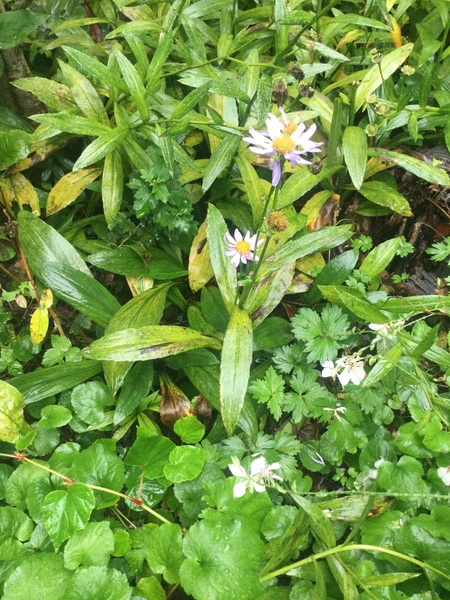
Aster koraiensis (Korean starwort, "Chosenshion")
Japanese name: チョウセンシオン (朝鮮紫苑)
Scientific name: Aster koraiensis
[Overview]
A perennial 40–80 cm tall.
It has creeping underground stems.
It is hairless throughout, and the stem is erect.
There are basal leaves and stem leaves; the basal leaves are about 22 cm long and 3 cm wide and usually remain without withering even at flowering time.
The stem leaves are simple and alternate, broadly lanceolate to narrowly elliptic, 12–19 cm long and 1.5–3 cm wide, with a sharply pointed tip, stalkless and clasping the stem.
The leaves are thick, and the leaf margins have low teeth.
A single flower head is borne at each stem tip or branch tip.
The flower heads are about 3–5 cm across, with pale purple ray florets and yellow tubular florets.
The involucral bracts are ovate to elliptic and in 4 rows, and the involucre is hemispherical.
The fruit is an achene without a pappus.
[History]
It was introduced as an ornamental in the Taisho era and has become naturalized, mainly in the Kanto region.
[Cultivation]
Propagate from seed or by division.
It prefers well-drained sites in sun to partial shade that do not receive the afternoon sun.
It is best planted under deciduous trees that provide partial shade in summer.
It is vigorous and, if the environment suits it, grows well even when left alone.
For potted plants, water thoroughly when the soil surface dries; for plants in the ground, rainfall is sufficient.
Fertilizer is not much needed, but for potted plants a small amount of slow-release fertilizer with equal parts of the three components may be given in spring.
Remove spent flowers promptly after flowering.
Pests and diseases include slugs, cutworms and aphids.
Details
Japanese: チョウセンシオン(朝鮮紫苑)、チョウセンヨメナ(朝鮮嫁菜)、ナツシオン(夏紫苑)
Translated from our Japanese encyclopedia. If anything differs, the Japanese page is correct.