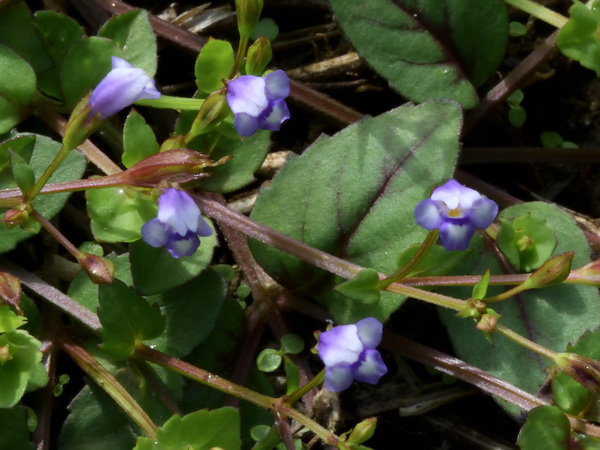
Japanese name: ウリクサ(瓜草) Scientific name:Lindernia crustacea
[Overview]
An annual commonly seen in fields and on rice paddy banks.
The stems branch and spread along the ground, reaching 10–20 cm in length.
The stems are hairless and square in cross section.
The leaves are simple and opposite, ovate, 0.7–2 cm long and 0.6–1.3 cm wide, with teeth on the margin.
The leaf stalk is 0.2–0.7 cm long.
The flowers are solitary in the leaf axils on the upper part of the stem, 0.7 cm long and pale purple, tubular with a two-lipped tip.
The upper lip is shallowly 2-lobed, and the lower lip is 3-lobed with a blue-purple mark on the central lobe.
The flower color is slightly deeper at the edges of the petals.
The calyx is shallowly 5-lobed and has 5 longitudinal ridges.
The fruit is an elliptic capsule 0.4–0.5 cm long, enclosed in a calyx of almost the same length.
[Notes]
The Japanese name likens the shape of the fruit to the makuwa-uri (oriental melon).