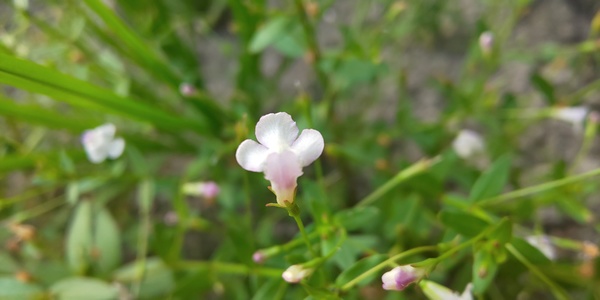
Japanese name: アゼナ(畦菜) Scientific name:Lindernia procumbens
[Overview]
An annual 5–20 cm tall, found in wet places such as rice paddies.
The stem is hairless and branched.
The leaves are simple and opposite, elliptic, about 1.5–2.5 cm long and 0.6–1 cm wide, with 3–5 palmate veins, hairless on both sides, and with entire margins.
There is no leaf stalk.
The flowers are solitary at the ends of long flower stalks arising from the upper leaf axils, and the flower stalk is as long as the leaf or about 1.5–2 times its length.
The flowers are very pale reddish purple and lip-shaped; the upper lip is shallowly 2-lobed, and the lower lip is 3-lobed.
There are 4 stamens, all fully formed and bearing anthers.
The fruit is an ovoid-globose capsule.