EVERGREEN

Plant Encyclopedia

Veronica ornata

Veronica ornata ("Toteiran")

Japanese name: トウテイラン (洞庭藍)
Scientific name: Veronica ornata

Veronica ornata

[Overview]
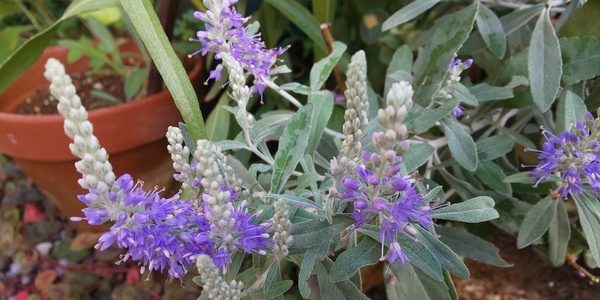
A perennial 50–60 cm tall, growing on seashores and in pine forests near the coast.
The whole plant is densely covered with white woolly hairs and looks whitish.
Leaves are simple and opposite, narrowly obovate, 5–10 cm long and 1–2.5 cm wide, with a few serrations on the margin.
There are no leaf stalks.
Racemes at the stem tips bear dense bluish purple flowers.
The corolla is 4-lobed.
The calyx is also densely covered with white woolly hairs.
The fruit is a spherical capsule.

[Cultivation]
Propagate from seed, by division, or by stem cuttings.
It prefers a sunny, well-drained site.
For potted plants, water thoroughly when the soil surface dries; for plants in the ground, rainfall is sufficient unless summer brings a long spell of sunny weather and the soil becomes severely dry.
Apply slow-release fertilizer in spring and autumn.
Pests and diseases include powdery mildew, gray mold and aphids.

[Notes]
The Japanese name compares the color of the flowers to the color of the water of Lake Dongting in China.

Details

Names
Japanese: トウテイラン(洞庭藍)
Life form
Perennial
Habit
Terrestrial
Planting (or sowing) season
March, April, September, October, November
Flowering season
August, September
Distribution or origin
Japan (Honshu: Sea of Japan coast of Kyoto, Hyogo and Tottori; Oki Islands)
Height
500–600 mm
Leaf shape
Simple leaf (unlobed)
Leaf arrangement
Opposite
Leaf margin
Serrate
Inflorescence
Raceme
Flower color
Blue, Purple
Leaf color
Green
Availability of seeds and plants
Low
Form sold
Seedlings
Propagation
Seed, Division, Bud cuttings
Sun exposure
Full sun
Water needs
Moderate
Soil needs
Required
Tolerance
Cold tolerance, Heat tolerance, Drought tolerance, Salt-spray tolerance
Suitable uses
Rock garden, Potted plant, Flower bed, Parks and gardens, Container
Diseases
Powdery mildew, Gray mold
Pests
Aphids
Designated plants
VU: Vulnerable (Class II), Endemic to Japan
Japan Flower Trade Code
54736

Translated from our Japanese encyclopedia. If anything differs, the Japanese page is correct.

Sponsored