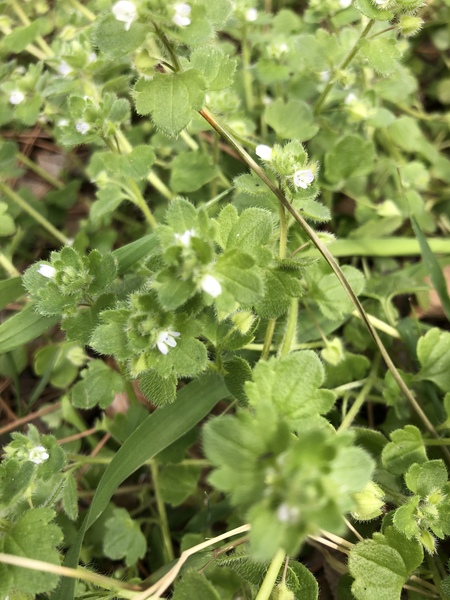
Japanese name: フラサバソウ Scientific name:Veronica hederifolia
[Overview]
A biennial found in fields and by roadsides.
The stems branch freely at the base and spread in all directions, with the upper parts rising obliquely.
The stems bear sparse long hairs.
The leaves are simple, opposite on the lower part of the stem and alternate on the upper part.
The leaves are broadly rounded, 0.7–1 cm long and 0.8–1.2 cm wide, somewhat fleshy and glossy, with sparse hairs on both surfaces.
The leaf margin has 1–2 pairs of large teeth.
Flowers are borne singly in the leaf axils.
The corolla is 4-lobed, 2–2.5 mm across and pale bluish purple.
The calyx is ovate-triangular with a pointed tip, and the margin bears long white hairs.
The fruit is a spherical capsule with a shallow depression in the center.
[History]
It was first reported in Nagasaki in 1867 and has become naturalized throughout Japan.
[Notes]
The Japanese name is taken from the initials of the French scholars Franchet and Savatier, who reported this plant again.