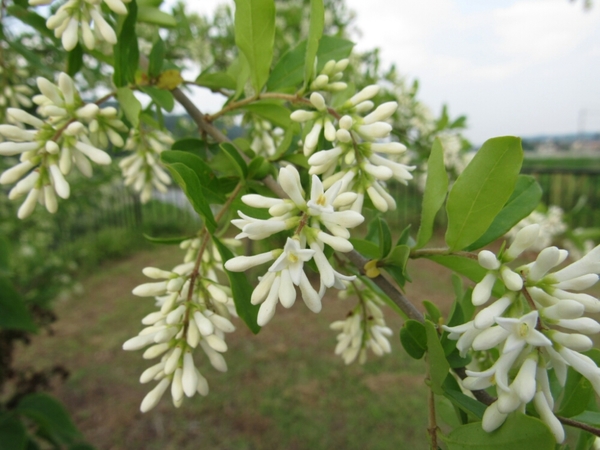
Japanese name: イボタノキ(水蝋樹) Scientific name:Ligustrum obtusifolium subsp. obtusifolium
[Overview]
A deciduous tree 2–4 m tall, found at forest edges from lowlands to mountains.
It branches well, and the young branches have fine hairs.
Leaves are simple and opposite, oblong, 2–5 cm long and 0.7–2 cm wide, thin, with entire margins.
Racemes 2–4 cm long are produced at the branch tips.
The flowers are white and 0.7–0.9 cm long; the corolla is 4-lobed.
The fruit is an elliptical-globose berry 0.6–0.7 cm long, ripening blackish purple.
[Uses]
It is often infested by a scale insect called ibota scale insect, and the wax secreted by this insect (ibota wax) is used as wax and for medicine.
[Cultivation]
Propagate from seed or by cuttings.
It prefers fertile soil in a sunny, well-drained site, but grows well without being particular about soil.
It tolerates shade, but flowers poorly if the site is not sunny enough.
It is hardy and easy to grow.
Watering is unnecessary unless sunny weather continues in midsummer and the soil becomes severely dry.
Fertilizer is not particularly necessary either, but depending on growth, apply a small amount of oil cake as fertilizer in winter.
It also tolerates pruning well.
Pests and diseases include the ibota scale insect.