
Plant Encyclopedia

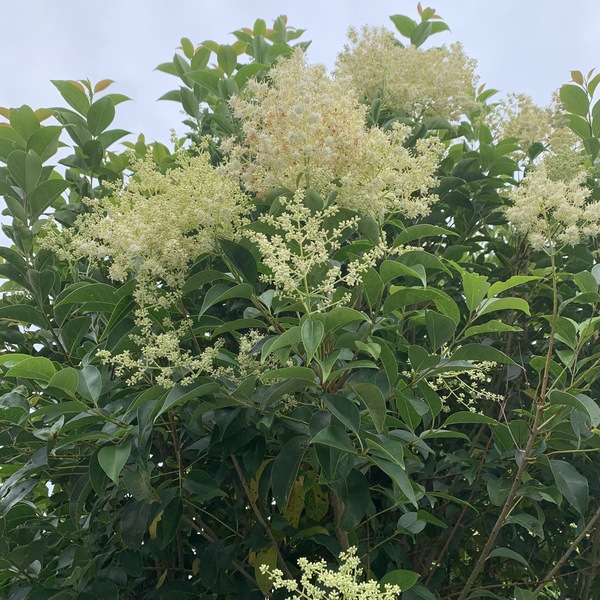
Ligustrum lucidum (broad-leaf privet, "Tonezumimochi")
Japanese name: トウネズミモチ (唐鼠黐)
Scientific name: Ligustrum lucidum
[Overview]
An evergreen tree about 25 m tall.
Leaves are simple and opposite, ovate-elliptic, 6–17 cm long and 3–8 cm wide, with entire margins.
Cymose panicles 8–20 cm long and 8–25 cm wide at the branch tips bear many flowers.
The flowers are white, 3–4 mm long, and the corolla is 4-lobed.
The fruit is ovate-elliptic, 7–10 mm long and 4–6 mm wide, and ripens to blackish purple.
[Uses]
The fruit is used medicinally as a tonic.
It is often infested by a scale insect called Ibota-kaigaramushi, and the wax secreted by this insect (ibota wax) is also used as wax and medicinally.
[Cultivation]
Propagate from seed and cuttings.
It prefers sunny, well-drained, slightly moist places, but is not particular about soil and tolerates shade.
It is hardy and grows easily.
Watering is unnecessary unless midsummer brings a long spell of sunny weather and the soil becomes severely dry.
Fertilizer is also not particularly necessary, but if the leaf color becomes poor, apply slow-release fertilizer in winter.
It also tolerates pruning well.
Pests and diseases include leaf spot and Ibota-kaigaramushi (scale insect).
[Notes]
It resembles Nezumimochi, but can be distinguished by being taller, having larger leaves and inflorescences, thinner leaves with long, slender, pointed tips, and by the lateral veins showing through clearly when a leaf is held up to the sun.
Details
Japanese: トウネズミモチ(唐鼠黐)
Translated from our Japanese encyclopedia. If anything differs, the Japanese page is correct.