
Plant Encyclopedia

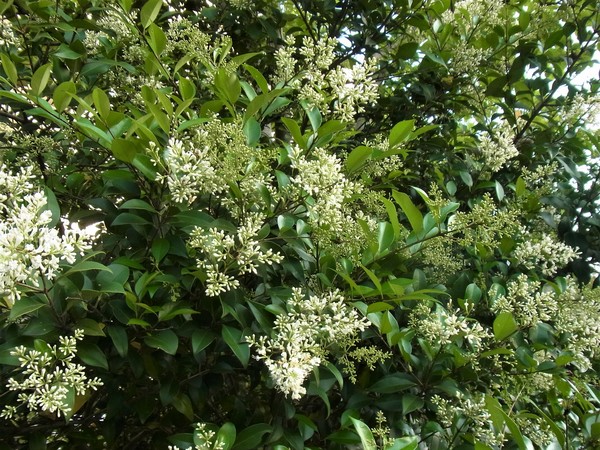
Ligustrum japonicum var. japonicum (Japanese privet, "Nezumimochi")
Japanese name: ネズミモチ (鼠黐)
Scientific name: Ligustrum japonicum var. japonicum
[Overview]
An evergreen small tree 2–3 m tall.
It is found in laurel forests, and is especially common along the coast.
It branches well.
Leaves are simple and opposite, ovate-elliptic, 4–8 cm long and 2–5 cm wide, with entire margins.
Panicles 5–12 cm long at the branch tips bear many flowers.
The flowers are white, 5–6 mm long, and the corolla is 4-lobed.
The fruit is elliptic, 8–10 mm long, and ripens to blackish purple.
[Uses]
The fruit is used as a tonic and the leaves for boils.
[Cultivation]
Propagate from seed and cuttings.
It prefers sunny, well-drained, slightly moist places, but is not particular about soil and tolerates shade.
It is hardy and grows easily.
Watering is unnecessary unless midsummer brings a long spell of sunny weather and the soil becomes severely dry.
Fertilizer is also not particularly necessary, but if the leaf color becomes poor, apply slow-release fertilizer in winter.
It also tolerates pruning well.
Pests and diseases include leaf spot and Ibota-kaigaramushi (scale insect).
[Notes]
It resembles To-nezumimochi, but can be distinguished by being smaller, having thicker leaves, and by the lateral veins not showing through when a leaf is held up to the sun.
The Japanese name compares the branches and leaves to Mochinoki and the fruit to mouse droppings.
Details
Japanese: ネズミモチ(鼠黐)、タマツバキ(玉椿)
Translated from our Japanese encyclopedia. If anything differs, the Japanese page is correct.