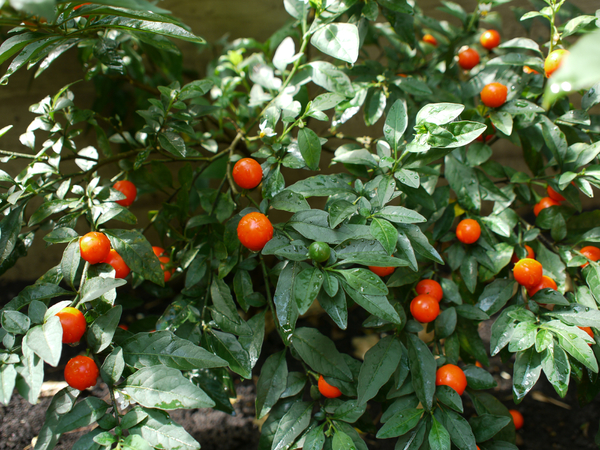
Solanum pseudocapsicum var. pseudocapsicum(Jerusalem cherry, "Tamasango")
Japanese name: タマサンゴ(玉珊瑚) Scientific name:Solanum pseudocapsicum var. pseudocapsicum
[Overview]
An evergreen shrub 30–50 cm tall.
It is not very cold-hardy, so horticulturally it is treated as an annual.
It branches freely, and the branches are green and have no thorns.
The leaves are simple and alternate, ovate, with wavy, entire margins.
There is a short petiole.
Umbels borne opposite the leaves or partway along the branches carry 1–4 flowers.
The corolla is 1.2–1.5 cm across, white, and 5-lobed.
The fruit is spherical, 1.5 mm across, and ripens from yellow to red.
[History]
Introduced as an ornamental in the middle of the Meiji period, it has become naturalized in warm regions.
[Cultivation]
Propagate from seed.
It dies when exposed to frost or cold wind, so in cold regions grow it in a pot and bring it indoors to a sunny spot in winter.
In warm areas west of the Kanto region it can overwinter outdoors.
It grows well in any soil as long as the site is sunny and well drained.
It dislikes excess moisture.
For potted plants, water thoroughly when the soil surface dries; for plants in the ground, rainfall is sufficient.
Fertilizer is not particularly necessary.
There are no particular pests or diseases.
[Notes]
There is also a theory that most of the Tama-sango seen in Japan is actually Hime-tama-sango.