
Plant Encyclopedia

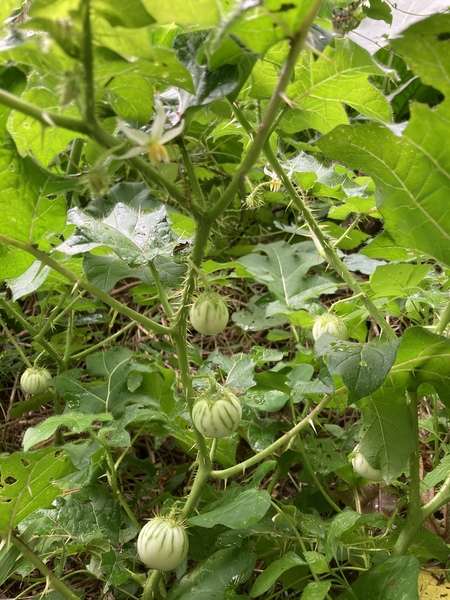
Solanum capsicoides (cockroach berry, "Kinginnasubi")
Japanese name: キンギンナスビ (金銀茄子)
Scientific name: Solanum capsicoides
[Overview]
A perennial 0.5–1 m tall, found along roadsides and in wasteland.
The stem is erect or rising obliquely and branches; it bears sparse dotlike hairs, and together with the flower stalks and calyx it bears many thick, sharp prickles of uneven length.
The leaves are simple and alternate, broadly ovate, 3–12 cm in both length and width, with sparse hairs on the surface and margin, and 2–3 large teeth on the margin.
Umbels arise partway up the stem, bearing 1–5 flowers in a bundle.
The corolla is white, 2 cm across, and 5-lobed in a star shape.
The fruit is spherical, 3–4 cm across, at first white to yellow with green vertical stripes, later ripening red.
[History]
It is thought to have been introduced as an ornamental in the early Meiji period, and has become naturalized in warm regions.
[Notes]
The Japanese name comes from the fruit changing color as it ripens.
Details
Japanese: キンギンナスビ(金銀茄子)、ニシキハリナスビ(錦針茄子)
Translated from our Japanese encyclopedia. If anything differs, the Japanese page is correct.