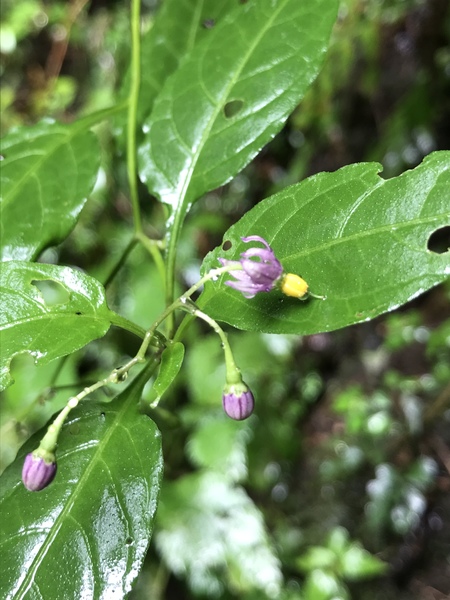
Japanese name: ヤマホロシ Scientific name:Solanum japonense var. japonense
[Overview]
A climbing perennial found at forest edges in the mountains.
It has a long rhizome.
The stem is hairless, extends somewhat like a vine, and branches sparsely.
The leaves are alternate, 3–8 cm long and 0.8–3 cm wide, triangular-ovate to triangular-broadly lanceolate, with a long, slender, pointed tip; the leaves on the lower part of the stem are sometimes 3–5-lobed.
The leaf margins are entire or have a few teeth.
The upper surface of young leaves bears short hairs but later becomes hairless.
The petiole is 1–3 cm long.
The flowers are borne in cymes.
The corolla is 1 cm across and pale purple, divided into 5 star-shaped lobes that later bend strongly backward.
At the base of each corolla lobe are 2 yellowish-green glands, and the inside of the throat is deep purple.
The fruit is spherical to elliptical, 0.6–0.7 cm across, and ripens red.
[Notes]
Tsurubana-nasu is sometimes sold under the name Yama-horoshi.