
Plant Encyclopedia

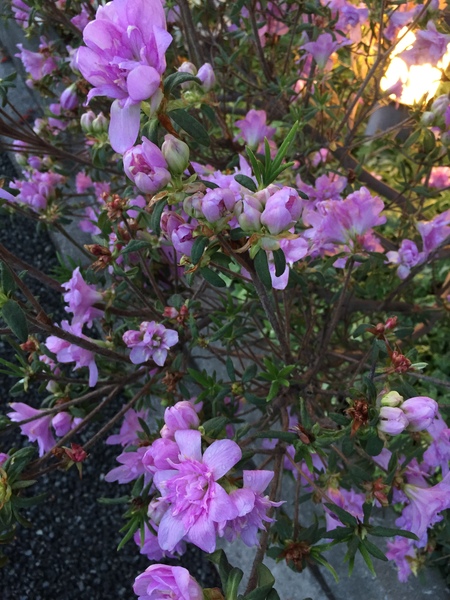
Rhododendron macrosepalum ("Mochitsutsuji")
Japanese name: モチツツジ (黐躑躅、餅躑躅)
Scientific name: Rhododendron macrosepalum
[Overview]
A semi-evergreen shrub 1–2 m tall, found in bright secondary forests such as red pine forests in low mountains and hills.
The whole plant is covered with many glandular hairs and is sticky.
There are two types of leaves, spring leaves and summer leaves, both simple and alternate.
Spring leaves are elliptic, 4–8 cm long and 2–4.5 cm wide, with long white hairs in addition to glandular hairs on both surfaces, and long brown hairs on the midrib of the underside.
Summer leaves are narrowly elliptic, 1.5–5 cm long and 1–2 cm wide, with long brown hairs in addition to glandular hairs on both surfaces.
Some of the summer leaves overwinter, and in winter their margins curl slightly toward the underside.
The petiole is 0.1–0.3 cm long.
The branch tips bear 2–5 flowers.
The flowers are pale crimson-purple, 4–6 cm across, and the corolla is funnel-shaped with 5 lobes.
Flower color varies in depth.
The upper side of the corolla has dark spots on the inner surface.
There are usually 5 stamens, sometimes 6–7.
The fruit is a capsule densely covered with glandular hairs.
[Cultivation]
Propagate from seed.
Cuttings are also possible, although the rooting rate is very poor.
It prefers fertilized, acidic soil that is sunny, well drained and moisture-retentive.
Avoid dry sites, or prevent the base of the plant from drying out by mulching or similar means.
For potted plants, it is best to place them in partial shade out of the afternoon sun and direct sunlight in summer, and in a sunny spot protected from cold wind from autumn to spring; for plants in the ground, a site shaded by deciduous trees is best.
For potted plants, from autumn to spring water thoroughly when the soil surface dries, and in midsummer water twice, in the cooler morning and evening, so that the leaves are also wetted.
For plants in the ground, rainfall is sufficient except in summer; in summer, water in the cooler morning or evening so that the leaves are also wetted, and in winter, if dry weather continues, water in the morning on a warm day.
Apply fertilizer three times in total, in winter, after flowering, and in autumn, using organic fertilizer or slow-release chemical fertilizer with equal parts of the three components, spread around the plant.
Do not prune; limit work to rubbing off excess buds in early summer after flowering to tidy the shape of the tree.
Remove spent flowers promptly.
Pests and diseases include spider mites, Tsutsuji-gunbaimushi and Benimon-aoringa.
Details
Translated from our Japanese encyclopedia. If anything differs, the Japanese page is correct.