
Plant Encyclopedia

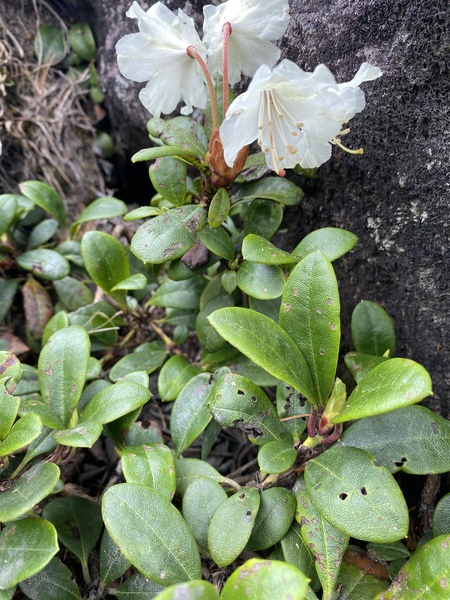
Rhododendron aureum ("Kibanashakunage")
Japanese name: キバナシャクナゲ (黄花石楠花)
Scientific name: Rhododendron aureum
[Overview]
An evergreen shrub 0.2–1 m tall with creeping branches, growing in dwarf stone pine thickets and sunny rocky places in high mountains.
The leaves are simple and alternate, 2–5 cm long and 1–2 cm wide, elliptic, thick and leathery, hairless on both surfaces, with a wedge-shaped base.
Clusters of 2–7 flowers bloom at the branch tips.
The flowers are 2.5–3 cm across, pale yellow, funnel-shaped to bell-shaped, with 5 rounded lobes.
The fruit is a capsule.
[Cultivation]
Propagate from seed or by cuttings.
It suits cool regions and dislikes heat and humidity.
It prefers a well-drained, moisture-retentive, well-ventilated acidic soil, and soil for mountain wildflowers is suitable.
On flatland, place it in partial shade out of the afternoon sun and direct summer sunlight; in cool regions, place it in a sunny spot.
In autumn and spring, water thoroughly when the soil surface dries; in warm regions it becomes dormant in summer and stops taking up water, so water sparingly, protect it from rain from the rainy season through the long autumn rains, and in winter water so that the soil does not dry out completely.
Little fertilizer is needed: in early spring or autumn, place slow-release compound fertilizer on the soil or give diluted liquid fertilizer, so that no fertilizer remains in summer.
Pick off spent flowers frequently.
Pests and diseases include root rot, gray mold, brown spot, flower blight caused by sclerotinia, Pestalotia disease, aphids, scale insects, leafrollers, armyworms and borers.
Details
Translated from our Japanese encyclopedia. If anything differs, the Japanese page is correct.