
Plant Encyclopedia

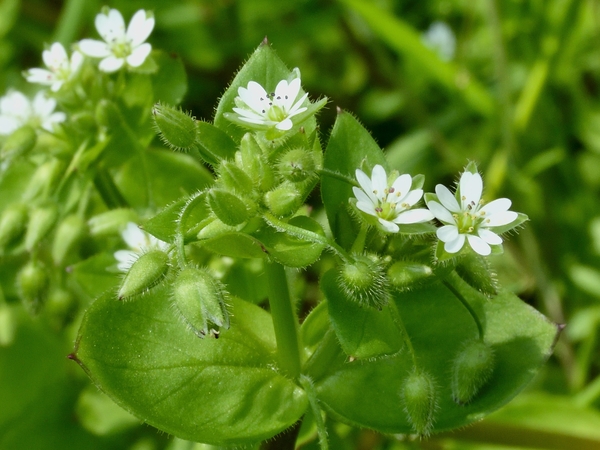
Stellaria neglecta (greater chickweed, "Midorihakobe")
Japanese name: ミドリハコベ (緑繁縷)
Scientific name: Stellaria neglecta
[Overview]
An annual or biennial about 10–30 cm tall, found in fields and along roadsides.
The stems and leaves are soft, and the stem is green and branches from the base and spreads.
The stem has short soft hairs on one side.
Leaves are simple and opposite, ovate, 1–3 cm long and 0.6–2 cm wide, with a pointed tip and hairs on the underside.
The leaves on the lower part of the stem have petioles.
Cymes are borne at the stem tips and in the leaf axils.
The flowers are small, white and 5-petaled, but because the petals are deeply split in two, they look as if they have 10 petals.
There are 4–10 stamens, and the anthers are purplish brown.
The fruit is an ovoid capsule.
The seeds are reniform-round, 1–1.1 mm across and black, with cylindrical projections on the surface.
[Uses]
As one of the Seven Herbs of Spring, the young leaves are eaten.
The stems and leaves are used as a folk remedy.
They are also used as food for small birds, rabbits and the like.
Details
Japanese: ミドリハコベ(緑繁縷)、ハコベ(繁縷)
Translated from our Japanese encyclopedia. If anything differs, the Japanese page is correct.