
Plant Encyclopedia

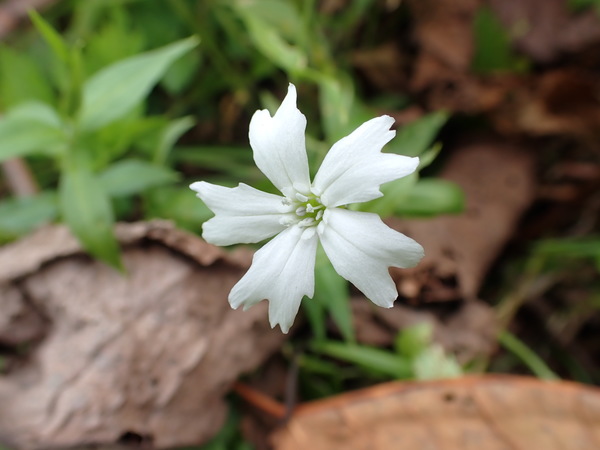
Silene gracillima ("Senjuganpi")
Japanese name: センジュガンピ (千手岩菲)
Scientific name: Silene gracillima
[Overview]
A perennial 0.4–1 m tall, found in moist places in forests and at forest edges from the mountains to the subalpine zone.
The stem is erect, branches in the upper part, and has soft hairs.
The leaves are simple and opposite, lanceolate, 5–14 cm long and 1–3.5 cm wide, with pointed tips; they are stalkless, thin and rather soft, with entire margins.
The flowers are borne sparsely in dichasial cymes and are white, 5-petaled, and about 2 cm across.
The petals open flat and are shallowly divided in two, with margins that are jagged.
There are 10 stamens.
The calyx is cylindrical but becomes bell-shaped when in fruit.
The flower stalks are slender, 2–6 cm long.
The fruit is an ovoid capsule that splits into 5 at the top to release the seeds.
[Cultivation]
Propagate from seed, by division, or by shoot cuttings.
It prefers sun to partial shade and a well-drained, fertile, slightly moist soil.
Take care not to let it dry out; for potted plants, water thoroughly when the soil surface dries, and for plants in the ground, rainfall is sufficient unless summer brings a long sunny spell and the soil dries out.
Besides base fertilizer, apply slow-release fertilizer placed on the soil in spring and autumn.
Pinching in May–June encourages side shoots and increases the number of flowers.
There are no particular pests or diseases.
[Notes]
The Japanese name is said to have been given because the plant was discovered at Senjugahama on Lake Chuzenji in Nikko, Tochigi, and resembles the Senno (岩菲), which is native to China.
Another theory compares the cuts in the petals to the hands of Senju Kannon (the thousand-armed Kannon).
Details
Translated from our Japanese encyclopedia. If anything differs, the Japanese page is correct.