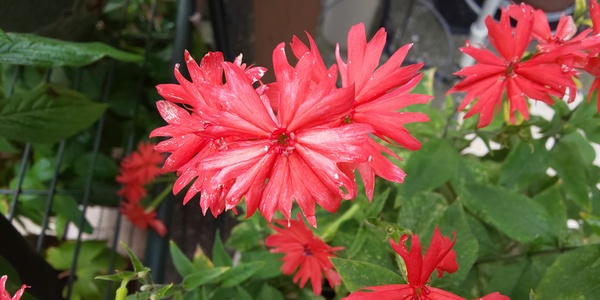
Japanese name: センノウ(仙翁) Scientific name:Silene bungeana
[Overview]
A perennial 0.5–1 m tall.
The whole plant is hairy, and the stems are erect, sometimes branching in the upper part.
The leaves are simple and opposite, elliptic-lanceolate, 8–12 cm long and 2–3 cm wide, with pointed tips, soft hairs on both surfaces and entire margins.
The flowers are borne rather densely in dichasial cymes; they are 5-petaled, deep crimson to bright vermilion, and 3.5–5 cm across.
The petals open flat and are irregularly and finely cut.
There are 10 stamens, and the anthers are dark purple.
The fruit is an elliptic-ovate capsule 1–1.5 cm long, but the plants cultivated in Japan are triploid and do not produce seed.
[History]
It came from China in the late Kamakura period to the early Muromachi period.
[Cultivation]
Propagate by division or stem cuttings.
It prefers well-drained soil in sun to partial shade.
For potted plants, water thoroughly when the soil surface dries; for plants in the ground, rainfall is sufficient unless summer brings a long spell of sunny weather and the soil becomes severely dry.
Apply base fertilizer, and in addition place slow-release fertilizer on the soil in spring and autumn.
Armyworms can occur.