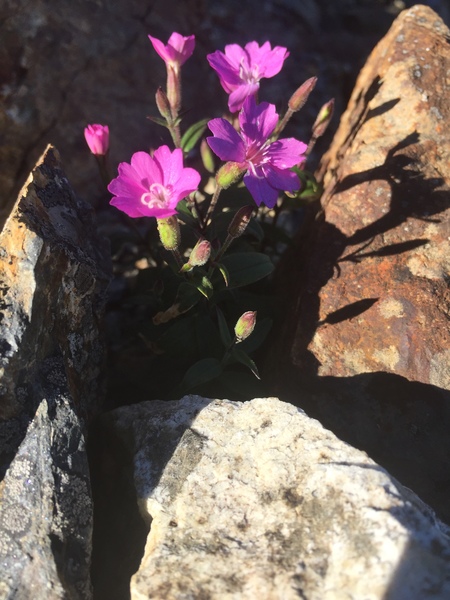
Japanese name: タカネビランジ Scientific name:Silene akaisialpina
[Overview]
A perennial 10–20 cm tall, found on rocky, gravelly ground in the Southern Alps.
The stem has upward-pointing hairs.
The leaves are simple and opposite, lanceolate, 1.5–4 cm long and 0.3–1 cm wide, with hairs on the leaf margin.
The flowers are borne singly or in pairs at the stem tip and are reddish purple to pale pink, 5-petaled and 2.5–3 cm across.
The petals open flat and are shallowly 2-lobed at the tip.
The flower stalk has glandular hairs.
The fruit is a capsule.
[Cultivation]
Propagate from seed or by division.
It prefers well-drained, well-aerated soil.
A sunny place suits it from autumn to spring, and a well-ventilated place in partial shade suits it in summer.
Avoid places that receive strong afternoon sun.
Water thoroughly when the soil surface dries.
It dislikes heat and humidity, so during hot periods water in the evening or later.
For plants in the ground, no fertilizer is particularly needed; for potted plants, place slow-release fertilizer on the soil in spring and autumn.
Pests and diseases include soft rot and aphids.