
Plant Encyclopedia

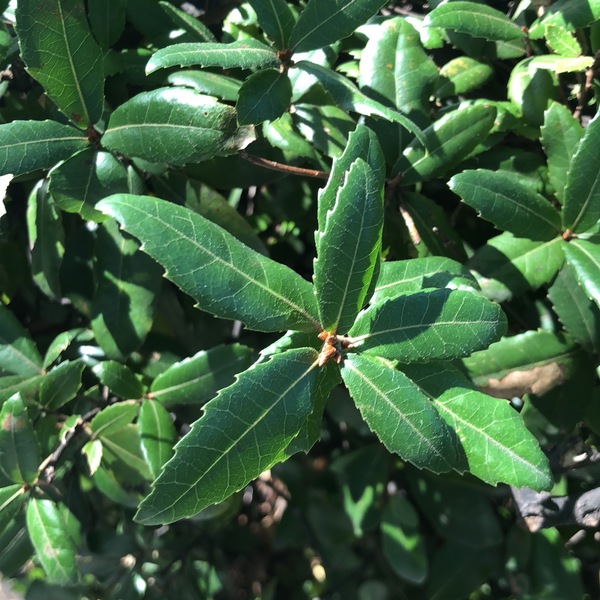
Quercus phillyreoides ("Ubamegashi")
Japanese name: ウバメガシ (姥目樫)
Scientific name: Quercus phillyreoides
[Overview]
An evergreen shrub to small tree 3–5 m tall, often found on rocky, gravelly ground near the seashore.
Some reach 10 m in height.
It branches well.
The bark is shallowly split lengthwise.
Leaves are simple and alternate, elliptic, 3–6 cm long, thick and hard.
Both surfaces of the leaf are at first covered with stellate hairs and short hairs along the midrib, but later become hairless.
The margin of the upper half of the leaf has low teeth.
The petiole is 0.5 cm long.
There are male flowers and female flowers.
The male flowers form catkins 2–2.5 cm long, densely covered with stellate hairs, and many hang down from the base of the new branches.
The female inflorescences are borne 1–2 in the leaf axils at the top of the new branches.
The fruit is an elliptic nut (acorn) 2 cm long, which ripens in autumn of the following year; the cupule (acorn cap) is cup-shaped, and the involucral scales are arranged like overlapping roof tiles.
[Uses]
The bark and leaves are used as a mordant and a tanning agent.
It is used as firewood and charcoal material, and is a raw material for binchotan charcoal.
[Cultivation]
Propagate from seed.
The germination rate drops if acorns are dried, so sow them immediately after collecting, or keep them moist until spring.
It prefers sunny, airy, well-drained, fertile soil.
For potted plants, water thoroughly when the soil surface dries; for plants in the ground, rainfall is sufficient.
Apply organic fertilizer in winter and slow-release fertilizer in autumn.
Details
Translated from our Japanese encyclopedia. If anything differs, the Japanese page is correct.